



You’ve just wrapped up another 2,800-mile week. The logbook is full, the wheels kept turning, and you’re exhausted. But when the settlement hits your account, that familiar frustration sets in. After fuel, truck payments, insurance, and maintenance, what’s left feels thin.
You followed the golden rule: stay moving.
So why doesn’t the math add up?
You’re not alone – and it’s not your fault. Many owner-operators are caught in what can be described as the Busy Loop: an industry habit of confusing activity with progress. For years, drivers have been told that the solution to tight margins is to run harder and stay loaded at all costs. But experience – and data – point to a different truth:
The money isn’t in the miles. It’s in the margin.
Why being busy doesn’t lead to profit in trucking
Being busy doesn’t make owner-operators profitable because profit depends on margin per mile, not total miles driven. When revenue per mile fails to exceed true cost per mile – including fuel, maintenance, deadhead, and unpaid time – running more miles actually increases losses instead of income.
This is why many drivers work longer weeks without seeing meaningful improvement in take-home pay.
The Myth of “Stay Moving”
For many owner-operators, the pressure to stay moving is constant. Dispatchers encourage taking the next available load to avoid sitting. Empty miles feel like failure. Over time, this creates the belief that a truck that isn’t rolling is a business in trouble.
That mindset comes from survival instincts – but in today’s market, it no longer holds up mathematically.
According to the ATRI Operational Costs Report, the average cost per mile for an owner-operator has climbed beyond $2.00. Fuel prices, insurance premiums, truck payments, and maintenance expenses continue to rise year over year. At the same time, spot market boards regularly show loads paying $1.80–$1.90 per mile, often into weak reload markets.
At those rates, movement doesn’t generate cash flow. It generates losses.
And the problem rarely stops at the posted rate. Low-paying freight often brings additional costs that aren’t visible at booking but compound quickly once the load is underway. Unpaid detention adds hours without compensation. Lumping fees eat into settlements. Cheap freight frequently leads into poor reload markets, forcing long deadhead runs to find the next load. Industry data shows that deadhead can quietly reduce effective revenue by 20–30%, turning marginal loads into losing ones.
The real profit equation for owner-operators
Total revenue is a misleading metric. The equation that actually determines whether a trucking business survives is far simpler:
PROFIT = (Revenue Per Mile – Cost Per Mile) × Smart Miles
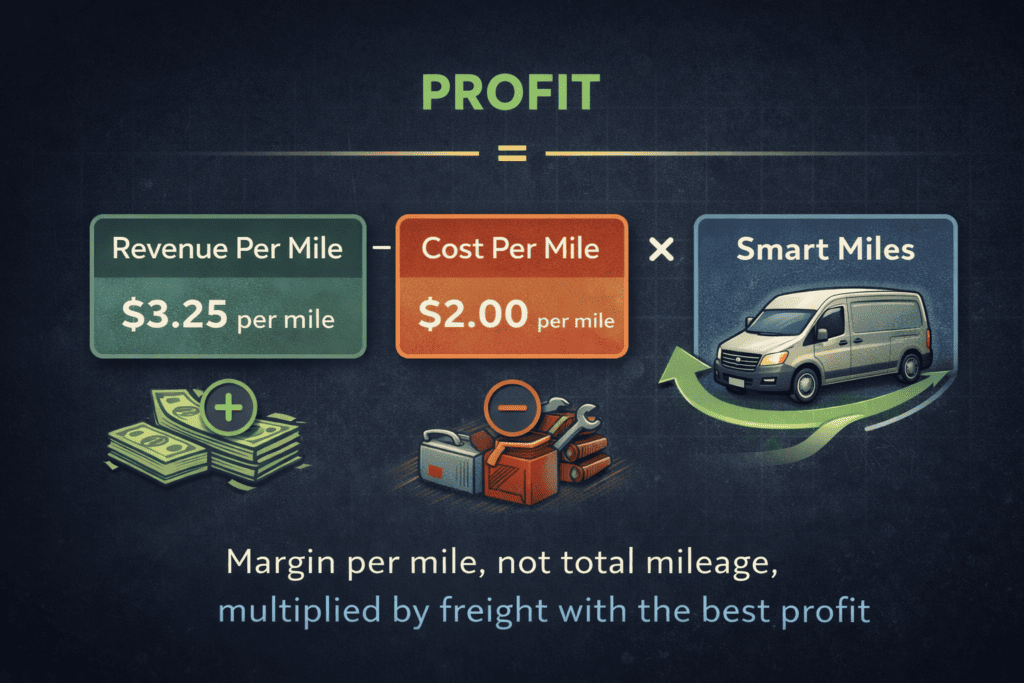
For owner-operators, profit is determined by the gap between revenue per mile and true cost per mile, multiplied only by miles that generate real margin.
High mileage without margin produces exhaustion – not income. A smaller number of well-selected, high-margin miles will consistently outperform weeks filled with break-even freight.
How this plays out in practice
| The Busy Loop | The Profit Path | |
| Core approach | Take any load to keep moving | Select freight strategically |
| Primary focus | Total miles | Margin per mile |
| Typical result | 2,800 mi × $2.10 = $5,880 revenueCost ≈ $2.00/mi → $5,600 Weekly profit ≈ $280 | 2,200 mi × $3.25 = $7,150 revenueCost ≈ $2.00/mi → $4,400 Weekly profit ≈ $2,750 |
| Lifestyle impact | Constant pressure, unpredictable time | Planned runs, controlled schedule |
The truck moves less – but the business earns more. Stability doesn’t come from chasing random freight — it comes from repeating lanes that consistently work.
How profitable owner-operators evaluate freight
Owner-operators who escape the Busy Loop stop asking “Do I need a load?” and start asking better questions:
- Does this rate clear my true cost per mile with margin?
- Does this lane lead into a strong reload market – or a freight desert?
- Will the shipper and receiver respect my time?
- Does this work support my long-term business health and personal schedule?
This type of selectivity isn’t laziness. It’s professional discipline – and it’s what separates survival from sustainability. Many operators accept loads without calculating their real cost per mile first.
What this means for owner-operators today
In today’s market, profitability comes from running fewer, better-structured loads, not maximizing weekly miles. Owner-operators who prioritize margin, time control, and freight reliability consistently outperform those chasing volume alone.
This shift isn’t emotional. It’s strategic.
Why expedited freight aligns with the Profit Path
So where do consistent, high-margin loads actually exist?
This is where expedited freight begins to make sense as a business model. It’s the practical application of the Profit Path.
Expedited freight isn’t simply “hot loads.” It’s time-sensitive, high-value freight where customers pay for speed, reliability, and execution – and that premium directly supports margin.
- Higher revenue per mile: Urgency has value, and expedited rates reflect that.
- Less detention: Time is priced into the move, reducing unpaid waiting.
- Reduced deadhead: Many expedited networks operate with planned lanes or paid repositioning.
- Stronger relationships: Reliability is the product, not a commodity. Drivers are treated as partners rather than interchangeable capacity.
Instead of chasing freight, quality freight begins to seek out reliable operators. A structured freight filtering system removes emotion from the booking process.
Taking control back
The “always be moving” mindset served a different era. Today, profitable trucking is about intelligent movement – choosing work that respects margin, time, and reliability.
Control over your bottom line doesn’t come from longer weeks or cheaper fuel cards. It starts at the moment you choose a load. It starts with valuing your service – and your time – more than the market’s lowest offer.
Stop measuring success in miles.
Start measuring it in margin.
Final takeaway
The next time you feel pressure to “just take a load,” pause and run the math. That moment of decision is where long-term profitability is built. For owner-operators who want to apply this margin-first approach in practice, exploring expedited owner-operator jobs built around vetted freight partners can be a logical next step.