


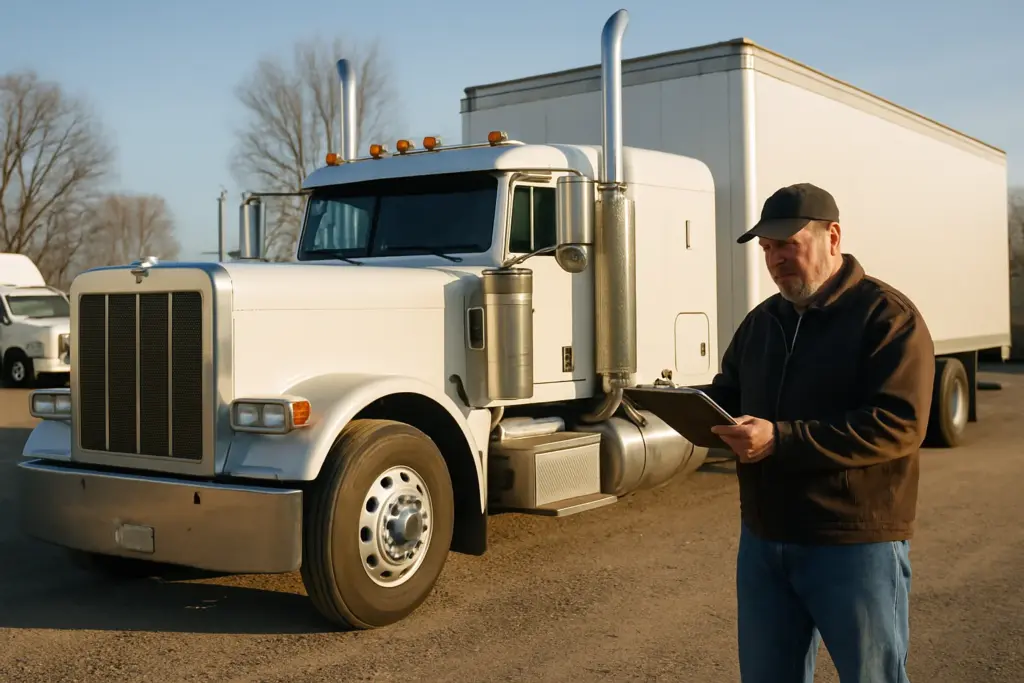
Re-Booking Every Day Is the Hidden Tax on Running Solo
Most owner-operators don’t think of themselves as starting from zero every morning, but that’s exactly what the open board makes you do. Yesterday’s good lane doesn’t carry over. The relationship you built with a broker on Monday doesn’t guarantee a load on Wednesday. You wake up, you open the same boards, and you go hunting for freight all over again as if the day before never happened. That re-booking grind feels like the job, but it’s actually a tax. It costs you time, it costs you negotiating leverage, and it quietly costs you the predictability that makes a trucking business worth running.
The operators who seem calm about freight aren’t gambling better than you. They’ve stopped re-booking from scratch. Somewhere along the way they built a lane they can count on, a stretch of freight that shows up whether or not a strong load happens to post that hour. That’s the difference between running a truck and running a business. One is a daily scramble. The other is a base you can plan around. And building that base is closer than most solo operators think, because it doesn’t require a fleet, a sales team, or a stack of direct-shipper contracts. It requires a steadier source of freight running underneath the open market.
This matters more for small carriers than anyone admits, because almost every expedited truck on the road is a small carrier. The vast majority of FMCSA-registered motor carriers operate six or fewer trucks, according to the agency’s large truck and bus statistics. That’s a market built almost entirely out of single trucks and tiny fleets, all pulling from the same open queue with no standing freight of their own. When you’re the one truck refreshing the board, you feel that structure as pressure. The way out isn’t hustling the board harder. It’s adding a lane that doesn’t reset every morning, the kind a structured freight program is built to give a single operator.
A lane you can count on isn’t a magic contract that pays above market forever. It’s a repeatable channel: freight that comes back to your truck on a rhythm you can see, so a slow morning on the boards doesn’t decide your week. Once you have that, the open market stops being survival and starts being upside. You take the strong load when it’s there, and you skip the cheap one without panic, because your base is already covered.
What a Countable Lane Actually Looks Like
“Predictable freight” gets thrown around a lot, so it’s worth being concrete about what separates a real lane from a lucky streak. A lane you can count on has three things going for it: it repeats on a rhythm you can plan around, it feeds you whether or not you’re glued to the board, and it holds up on the slow weeks when open freight thins out. A lucky streak has none of those. It feels great for ten days and then leaves you back at the boards wondering what changed.
The table below lines up the daily-scramble way of finding freight against the countable-lane way. Read it less as a sales pitch and more as a checklist for where your own week sits right now.
| What you’re judging | Re-booking every day | A lane you can count on |
|---|---|---|
| Where the day starts | From zero, hunting the board again | From a base that’s already feeding you |
| What controls your income | Whatever a broker posts that hour | A repeating rhythm you can plan around |
| Slow-week behavior | Income drops with the postings | Base holds, board becomes optional |
| Your negotiating position | Booking from need, taking weaker rates | Booking from strength, skipping cheap loads |
Look down the right-hand column and notice they’re all the same idea from different angles. Every one comes back to where your freight originates. When it comes only from the open board, every line in the left column is your reality whether you like it or not. When part of it comes from a lane that repeats, the right column becomes possible. The work of building a countable lane is really just the work of moving more of your week out of that left column.
It helps to put a number on what the scramble costs. Say re-booking eats the first ninety minutes of three mornings a week, between refreshing, calling, and waiting on a callback before you can roll. That’s better than four hours a week gone to finding freight you haven’t even hauled yet. Over a month it’s the better part of two working days spent shopping instead of driving. A countable lane doesn’t erase all of that, but it takes the floor of your week off the table so those mornings turn into miles instead of searching.
How You Actually Build the Lane
Building a lane you can count on starts with knowing your own week cold. Before you change a thing, track where your freight comes from for a month. Note which loads came off the open board, which came from a broker who called you back, and which repeated on a route you could have predicted. Most solo operators have never written this down, and once they do, the pattern is obvious: almost everything is coming from a single source that resets every day. You can’t build structure on top of a base you’ve never measured.
The next move is to stop treating every channel as equal. A repeating lane is worth more than a one-off load at the same rate, because it removes a future morning of re-booking, not just today’s. So when you’re deciding where to put your energy, weight the freight that comes back over the freight that pays a few dollars more once and disappears. This is the part most operators get backwards. They chase the highest single rate and ignore that a slightly lower lane that repeats four times beats a top rate they have to re-earn from scratch every time.
The fastest way to add a repeating base without a sales team is to plug into freight that’s already organized to come back to your truck. That’s the whole point of a structured freight program for owner-operators: consistent expedited loads outside the open-board queue, matched to your equipment and lanes, so part of your week is covered before you ever open a board. It isn’t a load board and it isn’t a dispatch service taking a cut of every move. It’s a parallel channel that gives a single truck the kind of standing freight a bigger fleet gets from volume. If you want the full breakdown of how that arrangement works under the hood, the explainer on how structured freight programs work walks through the mechanics start to finish.
You don’t leave the boards behind to do this. Keep working open freight and let it become the bonus layer on top of your base instead of the whole floor. The board is where you grab the strong load that beats your average, not the place you have to win every single day to make rent. That shift, from sole source to bonus layer, is what turns a scramble into a business. Same trucks, same lanes, same market. The difference is how many of your loads come back on their own.
The Week Feels Different When the Lane Holds
The real payoff of a countable lane isn’t a single rate. It’s what it does to how the week feels. When the board is your only source, every quiet morning is a problem you have to solve under pressure, and that pressure is exactly when you take loads you’d otherwise pass on. When a base lane is feeding you, the same quiet morning is just a morning you’re already covered for, and the board becomes a place to look for upside instead of a place you have to survive. The freight in the market didn’t change. The number of doors you can knock on did.
That’s also what lets you plan like an actual business. Truck payments, insurance, and maintenance don’t move with the board, so a base that holds steady is what makes the fixed costs feel manageable instead of menacing. You can schedule a service appointment without dreading the lost day. You can turn down a cheap load on a Friday because you already know what next week looks like. None of that is possible when every dollar depends on what posts in the next hour.
So the next time you catch yourself re-booking from scratch for the hundredth morning in a row, treat it as a signal, not a routine. Ask how much of your week comes from a source that resets every day, and how much comes back on its own. If the honest answer is “almost none of it comes back,” that’s not a hustle problem you fix by working the board harder. It’s a structure problem, and the fix is a lane you can count on. Build one piece of that base, and the daily scramble stops being the whole job.