

Short answer
With a straight truck, most of what a carrier checks comes back to weight. Under the federal CDL rules the line is 26,001 pounds, counting the truck’s rating or its actual loaded weight, whichever is greater. Cross it and you need at least a Class B CDL, and you fall under drug and alcohol testing and the Clearinghouse. IFTA is a separate test with its own weight measure. After weight, carriers look at your brakes, because they decide what your CDL allows, and at your sleeper, because only a berth that meets the federal spec counts as sleeper berth time.
Before a carrier can consider you for straight truck opportunities, they need to know what your truck can legally carry, whether your license matches the equipment, and whether your sleeper setup qualifies for longer runs. Here’s what to check before you apply.
Most guides lump box trucks and straight trucks together. For the general list of what an expedited carrier reviews before you run under it, such as insurance, your driver qualification file and your safety record, see our box truck expediting guide. This article covers only what changes when the truck is a heavier straight truck, often 24 to 26 feet with a sleeper. These are the questions that decide whether a carrier can put you on a load, and the ones you should be able to answer from your own paperwork before the call.
The 26,001 Pound Line Counts Loaded Weight, Not Just the Sticker
The federal CDL rules count a Heavy Straight Vehicle, Group B, as a commercial motor vehicle when it is “having a gross vehicle weight rating or gross vehicle weight of 11,794 or more kilograms (26,001 pounds or more), whichever is greater.” That is the definition in 49 CFR 383.5, and the last two words are the ones drivers miss.
The gross vehicle weight rating (GVWR) is the number on the label in the door jamb. The gross vehicle weight is what the truck actually weighs with you, fuel and freight on board. A truck rated at 26,000 pounds does not need a CDL by its rating. Load it so it scales at 26,500 pounds, and under the federal “whichever is greater” wording it meets the CDL definition of a commercial motor vehicle on that trip. It is also a truck loaded past its own rating, which is a problem by itself. A non-CDL driver in that truck with that load is a risk for the carrier and the driver alike.
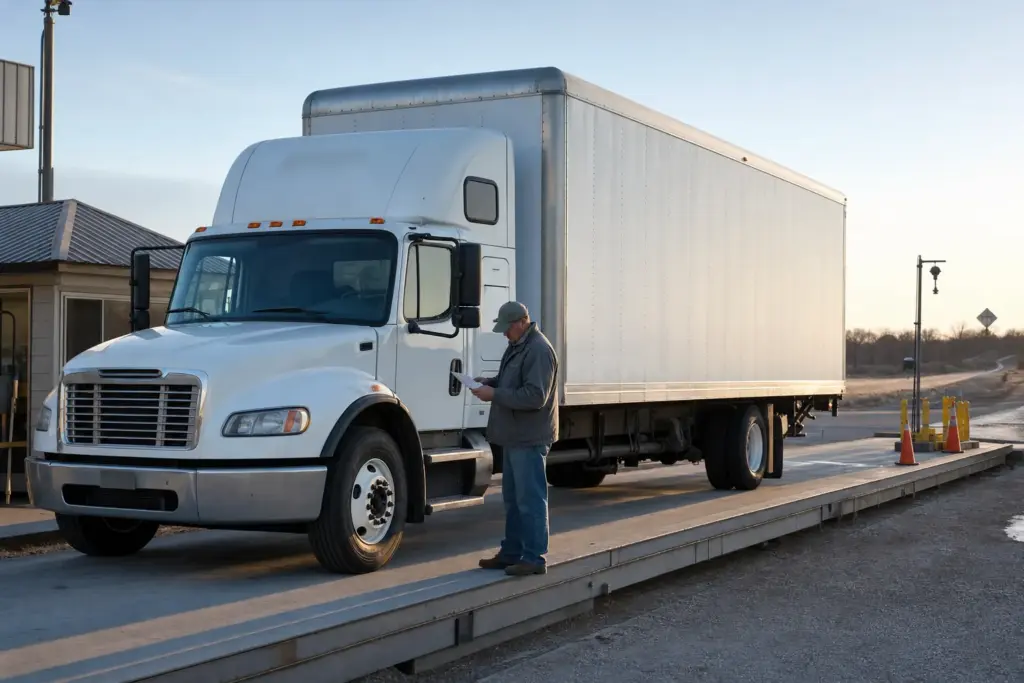
That is why a carrier asks two weight questions, not one: what the truck is rated for, and what it weighs empty. The difference between them is the freight you can legally carry. If you drive without a CDL, the useful number is how much freight keeps you under 26,001 pounds actual, not the GVWR.
Two limits on all of this. It is the federal rule for a single straight truck hauling property. Tow a trailer rated over 10,000 pounds and the combination can put you in Group A, and passengers or placarded hazmat bring their own CDL rules at any weight. States issue the license, and under 383.3 some drivers, such as military drivers, farmers and firefighters, are exempt or can be exempted. The vehicle group descriptions in 383.91 are written around the GVWR alone, so if your truck may scale over its rating, confirm with your state licensing office how it applies the actual weight wording before you run it without a CDL.
What Switches On Above 26,000 Pounds
Crossing the line changes more than the license. Here is what a carrier will look at on each side of it:
| Item | 26,000 lb or less | 26,001 lb or more |
|---|---|---|
| License | No CDL for weight alone* | Class B CDL or higher |
| Drug and alcohol testing | Part 382 does not apply | Part 382 testing applies |
| Clearinghouse | Not required | Pre-employment query before you drive (382.701) |
| IFTA, two axle truck | Not qualified if actual and registered weight stay at 26,000 lb or less | Qualified when actual or registered weight is over 26,000 lb; GVWR alone does not decide it |
| Hours of service, medical card | Same on both sides: an interstate truck at 10,001 lb or more is already a CMV under 390.5 | |
*In the license and testing rows, weight means the GVWR or actual weight, whichever is greater (383.5). The IFTA row uses actual or registered weight (IFTA R245). Passengers, placarded hazmat and towing a trailer are separate cases. The last row matters. Staying at 26,000 pounds or less keeps you out of the CDL and testing rows, and out of IFTA if your registered weight is also 26,000 or less, but a straight truck in interstate work is still a commercial motor vehicle. Hours of service and the rest of the federal safety rules follow you either way.
If you run under your own authority as the only driver, the testing rules treat you as both employer and driver. Section 382.103(b) says an employer who employs only himself or herself as a driver “shall implement a random alcohol and controlled substances testing program of two or more covered employees in the random testing selection pool.” In plain terms, you cannot be a random pool of one.
For IFTA, the primary source is the IFTA Articles of Agreement. Section R245 defines a qualified motor vehicle as one “having two axles and a gross vehicle weight or registered gross vehicle weight exceeding 26,000 pounds,” or “having three or more axles regardless of weight.” Note what is missing: the GVWR. A two axle truck rated at 26,001 pounds, registered at 26,000 and running lighter than that is not a qualified motor vehicle, even though the same truck needs a CDL. Under section R305, an IFTA license is required when a qualified motor vehicle operates in two or more member jurisdictions.


Your Brakes Decide What Your CDL Allows
Straight trucks come with full air brakes, air over hydraulic, or hydraulic brakes. For a CDL driver, the truck you took your skills test in shows up on your license. Under 49 CFR 383.95:
- Tested without air brakes, or failed the air brake knowledge test: the state must mark the CDL as restricted from operating a CMV “equipped with any type of air brakes.”
- Tested on air over hydraulic: the restriction covers any braking system “operating fully on the air brake principle.”
- Tested on an automatic: the CDL is restricted from a CMV with a manual transmission.
So a carrier will match your restriction codes to the truck, not just your class. A Class B driver with an air brake restriction cannot take a seat in a full air straight truck, even as the second driver on a team. Check the back of your license and know what your own truck has before you offer to run someone else’s.
A Sleeper Only Counts If It Meets the Federal Spec
A sleeper is what makes a straight truck useful for long expedited runs, and it is one of the first things a carrier asks about. The hours of service rules define a sleeper berth as “a berth conforming to the requirements of § 393.76.” A bunk that does not meet that section is not a sleeper berth for logging purposes. Key points of 393.76 for a berth installed today:
- Size: at least 75 inches long, 24 inches wide and 24 inches high, measured from the top of the mattress.
- Location: in the cab or immediately next to it, and securely fixed to it. A berth built into the cargo box must be “securely compartmentalized from the remainder of the cargo space.”
- Exit: a direct way out into the driver’s compartment, through an opening at least 18 inches high and 36 inches wide.
- Equipment: bedding and a proper mattress, for example foam at least four inches thick.
- Air and safety: ventilation, tight against dust and rain, protected from exhaust and fuel leaks, and a restraint rated for at least 6,000 pounds of forward force.
Why carriers care: for a property carrying truck, a compliant berth lets you split your 10 hour break under 395.1(g). One period has to be at least 7 consecutive hours in the berth, the other at least 2 hours, and together they must reach 10. On a team run, the berth time of at least 7 hours can be combined with up to 3 hours riding in the passenger seat while the truck is moving, taken immediately before or after the berth time, for at least 10 consecutive hours. A cot behind the seat or a mattress on top of the freight gives you none of that.
Know Your Truck Before the Call
Write these down once and keep them in the cab or on your phone. They are the answers a carrier or shipper will ask for, usually in this order:
- GVWR and empty weight: from the door label and a real scale ticket, not the brochure.
- Legal payload: the difference, and for a non-CDL driver, the lower number that keeps you under 26,001 pounds actual.
- Axles and registered weight: two or three axles, plus the weight on your registration. Together they settle the IFTA question.
- Brakes and transmission: full air, air over hydraulic or hydraulic, and manual or automatic.
- Box: length, inside height, door type and opening, and whether there is a liftgate and its rating.
- Sleeper: whether it meets 393.76, and whether you run solo or team.
- Your license: class, endorsements and restriction codes for every driver who will be in the seat.
Know Your Truck’s Specs? Let’s Find Your Carrier Match.
Tell us about your straight truck and qualifications. We’ll forward your information to carriers that may be a fit.
Apply With Your Straight Truck →If you are still choosing between truck sizes, our straight truck vs box truck earnings comparison looks at how the two classes compare on the money side.
Ready to Put Your Straight Truck to Work?
Looking for CDL or non-CDL straight truck opportunities? Apply for free. We’ll share your information with carriers that may match your equipment and qualifications.
Find Straight Truck Opportunities →Frequently Asked Questions
Do I need a CDL to drive a straight truck?
Under the federal rules, you need at least a Class B CDL if the truck’s GVWR or its actual loaded weight is 26,001 pounds or more, whichever is greater. Below that line, weight alone does not require a CDL, as long as you are not towing a trailer rated over 10,000 pounds, hauling placarded hazmat or carrying 16 or more people. States issue the license and some drivers are exempt, so confirm your exact setup with your state.
Does the bunk in my straight truck count as a sleeper berth?
Only if it meets 49 CFR 393.76. For a berth installed today that means at least 75 by 24 by 24 inches, located in or immediately next to the cab, an exit of at least 18 by 36 inches, a proper mattress, ventilation and an occupant restraint. A berth inside the cargo box must be securely walled off from the freight.
Do I need IFTA for a straight truck?
If the truck runs in two or more IFTA member jurisdictions, a two axle truck needs IFTA when its gross vehicle weight or registered gross vehicle weight exceeds 26,000 pounds. The GVWR alone does not decide it. A truck with three or more axles qualifies regardless of weight. If you run under a carrier’s authority, ask the carrier how fuel tax is handled for your truck.
How do I find straight truck opportunities through Expedited Jobs?
Apply for free with your truck details. Expedited Jobs lists CDL and non-CDL straight truck opportunities, no MC number is required to apply, and your information is shared with carriers that may match your equipment and qualifications.