

Short answer
A dock high box truck is built for freight that moves between buildings with loading docks: warehouses, distribution centers and cross-docks. A liftgate truck can also deliver where there is no dock at all, such as stores, offices, job sites and homes. Neither one is better in general. What matters is matching the loads you accept to the setup you already have, and asking the right questions before you say yes to a load that needs equipment you do not carry.
This is not a buying guide. If you are reading it, you most likely already run a 16 foot or 26 foot box truck, and the question is a practical one: a load offer says “liftgate required” or “dock to dock only,” and you need to know in a minute whether your truck can do it. Saying yes to the wrong load costs you a wasted trip, a refused delivery or a damaged pallet. Saying no to the right one leaves money on the table. Here is how to read your own truck the way a shipper or carrier will.
What “Dock High” and “Liftgate” Mean on a Load Offer
Two different questions
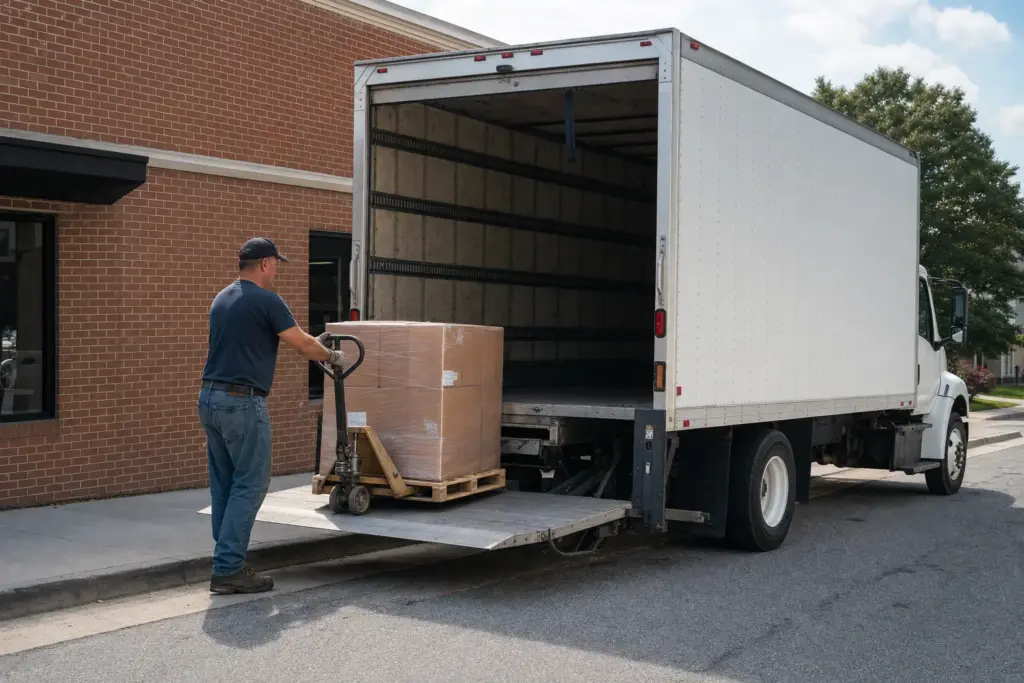
“Dock high” describes the truck’s cargo floor: it sits close to the height of a warehouse loading dock, so a forklift or pallet jack can roll straight from the dock into the box. “Liftgate” describes equipment: a powered platform on the back that raises and lowers freight between the cargo floor and the ground. A load offer that names one of them is telling you where the freight will be loaded or unloaded.
When a shipper writes “dock high,” they usually mean both ends have docks and they expect to load and unload with their own forklift. When they write “liftgate required,” at least one end has no dock, and the freight has to come down to street level on your truck’s equipment. Some trucks can do both. That depends on the type of gate and how it stows, which is the first thing to check on your own truck.
Two gate types you will see on box trucks are the tuck-under gate, which folds and stows under the body when not in use, and the rail gate, which runs on vertical rails at the rear doorway and folds flush against it. A tuck-under gate leaves the cargo area open for loading at a dock or by forklift. A folded rail gate covers part of the rear doorway, which can get in the way of a dock plate. Do not guess: back your truck up to a dock once while it is empty and see whether the floor meets the dock cleanly with the gate stowed.
Which Loads Fit Which Setup
Use this table to sort load offers against the truck you have today:
| Your setup | Loads it fits | Loads to turn down or question |
|---|---|---|
| Dock high, no liftgate | Warehouse to warehouse, distribution center runs, cross-dock transfers, freight with dock appointments at both ends | Any stop marked residential, retail without a dock, job site or “liftgate required” |
| Liftgate that stows clear of the rear | Most of both worlds: dock pickups plus deliveries to stores, offices and businesses without a dock | Single pieces heavier than the gate’s rated capacity, or pallets larger than the platform |
| Liftgate that folds against the back | Street level deliveries, small business and residential stops | Dock loads, until you have confirmed your truck can back flush to a dock with the gate up |
| Any liftgate, no pallet jack | Loose cartons and light pieces you can move by hand or dolly | Palletized freight to a stop with no forklift, because the gate only lowers the pallet, it does not move it |
Check Your Own Truck Before You Answer a Load Offer
Shippers and carriers ask about equipment because a mismatch shows up at the worst moment, at the delivery door. Five minutes with your own truck gives you answers you can repeat on every call:
- Gate capacity. Find the rating plate on the liftgate and write the number down. Compare it with the heaviest single piece in a load offer, not the total load weight. A pallet that weighs more than the gate’s rating should not go on the platform.
- Platform size. Measure the platform. A standard pallet plus a pallet jack and you all need to fit, or you will be making two trips down for one pallet.
- Dock fit. Back up to a dock empty, with the gate stowed, and see whether the floor meets the dock. If it does, you can honestly offer the truck for both dock and liftgate work.
- Pallet jack on board. A liftgate without a pallet jack only gets palletized freight down to the ground at stops that have their own forklift. Carry one if you plan to take liftgate deliveries.
- Securement. Liftgate stops often mean several drops on one run. Count your straps and load bars, and check your E-track, so freight for the third stop does not shift while you unload the first.
Keep those numbers on your phone. When you describe your truck to a shipper, a carrier or a network like ours, “26 foot, dock high, tuck-under gate, pallet jack on board” is the sentence that gets you matched with the right freight. Expedited Jobs puts it simply on its box truck jobs page: “We match loads to your truck.” The more exactly you describe your truck, the better that match can be.


Liftgate Deliveries Are Priced as Extra Work
In freight pricing, a liftgate is an accessorial: a service charged on top of the base rate. Large LTL carriers publish these charges in their tariffs. In Old Dominion Freight Line’s tariff ODFL 100-Q, item 891 charges shippers $4.40 per hundredweight for liftgate service at pickup or delivery, with a $115.00 minimum and a $330.00 maximum per shipment. The same item says the carrier “is not obligated to perform such service when suitable vehicles, equipped with such devices, and operators are not available.”
That is what a shipper pays a large LTL carrier, not what a box truck owner-operator is paid, so do not treat it as a rate. It does tell you two useful things. First, the freight industry treats a liftgate stop as separate work with its own price. Second, even a national carrier does not promise liftgate service unless the right truck and driver are available. A box truck that can do it is the scarce piece. When a load offer includes liftgate stops, it is fair to ask whether that work is reflected in the rate, and to compare it with a dock to dock load of similar miles before you accept.
Where a Dock High Truck Without a Gate Still Wins
A box truck without a liftgate is not second class. A lot of expedited and regional freight moves between businesses that have docks and forklifts on both ends: parts going from a supplier to a plant, inventory moving between warehouses, overflow freight between distribution centers. On those loads the gate adds nothing, and a truck that backs straight to the dock is exactly what the shipper wants.
The trade-off is the number of doors open to you. Without a gate, every stop has to have a dock or a forklift, so residential, retail and job site freight is off the table. If you run without one, say so up front and ask for dock to dock freight. Taking a load and discovering at delivery that the receiver has no dock is the fastest way to lose a shipper.
Questions to Ask Before You Accept a Liftgate Load
Liftgate freight goes wrong in predictable ways. These questions cover most of them:
- What is the heaviest single piece, and what are its dimensions? This is what has to fit on your platform and stay under your gate’s rating.
- Is the delivery at the curb, the door or inside? Inside delivery means stairs, hallways and elevators, and that is more time than a curbside drop.
- Who helps at the stop? Ask whether the receiver has staff or a forklift, or whether you are on your own with a pallet jack.
- What is the ground like? A gate needs a reasonably level, hard surface. Gravel, a steep driveway or a narrow street can make a delivery unsafe even with the right truck.
- Is there an appointment window? Business stops often receive only at set hours. Miss the window and you may be holding freight overnight.
For dock loads, the questions are shorter but still worth asking: whether there is a dock appointment, how long loading usually takes, and whether a lumper or unloading fee applies at the receiver.
Keep the Gate Earning
A liftgate only adds loads to your week if it works on the day. Run it through a full cycle at the start of the day, before you load, not at the first delivery. Look for hydraulic leaks, slow travel, and a platform that does not sit level. Keep the gate’s manual in the cab, along with the service intervals its maker sets. A gate that fails with freight on the platform turns a short stop into a redelivery, and that is the kind of thing shippers remember.
If you are still working out where your steady freight will come from, our guide on getting box truck contracts compares the main sources and what each one asks of you, including which ones expect a liftgate.
Ready to Put Your Box Truck to Work?
Expedited Jobs connects 16 foot and 26 foot box truck owner-operators with companies running spot market and direct customer freight. We match loads to your truck, pay is weekly, and no MC number is required to start.
Box Truck Jobs →Frequently Asked Questions
Do I need a liftgate to get box truck loads?
No. Plenty of box truck freight moves dock to dock between warehouses, plants and distribution centers, where the shipper and receiver load with their own forklifts. A liftgate opens up stops without a dock, such as stores, offices, job sites and homes. Without one, ask for dock to dock freight and turn down offers marked liftgate required.
Can a box truck with a liftgate still use a loading dock?
Often, yes. A tuck-under gate stows under the body and leaves the cargo area open for dock or forklift loading. A rail gate folds flush against the rear doorway and covers part of it, which can get in the way. Back your truck up to a dock once while it is empty, with the gate stowed, before you offer it for dock work.
How much is a liftgate fee?
It depends on the carrier. As one published example, Old Dominion Freight Line’s tariff ODFL 100-Q, item 891, charges shippers $4.40 per hundredweight for liftgate service, with a $115.00 minimum and a $330.00 maximum per shipment. That is what a shipper pays an LTL carrier, not what an owner-operator is paid.
Does Expedited Jobs match loads to my truck’s equipment?
The Expedited Jobs box truck page says: “We match loads to your truck.” Freight is based on the spot market and direct customer loads, with no dedicated lanes at this time, pay is weekly, and no MC number is required to start.

Table of Content
- What “Dock High” and “Liftgate” Mean on a Load Offer
- Which Loads Fit Which Setup
- Check Your Own Truck Before You Answer a Load Offer
- Have a Box Truck? Carriers Are Hiring.
- Liftgate Deliveries Are Priced as Extra Work
- Where a Dock High Truck Without a Gate Still Wins
- Questions to Ask Before You Accept a Liftgate Load
- Keep the Gate Earning
- Frequently Asked Questions