


Every owner-operator watches rate per mile. Fewer calculate their break-even rate per mile correctly.
That gap – between headline rate and real operating floor – is where weekly income becomes unstable.
In 2026, with diesel volatility, lane imbalance, and tightening margins across small carriers, understanding your owner-operator break-even rate is not optional. It determines whether a load builds stability or quietly erodes it.
What Is an Owner-Operator Break-Even Rate?
An owner-operator break-even rate per mile is the minimum rate required to cover every operating expense before profit.
That includes fuel, insurance, truck payments, maintenance reserves, tire wear, permits, compliance costs, deadhead miles, and driver labor. If any of those variables are excluded, the calculation is incomplete.
Break-even rate is not the regional average posted on a load board. It is not the number another driver claims to accept. It is your individual operating floor, based on your truck, your lanes, and your cost structure.
If you have not fully calculated your operating cost per mile, review how to determine it here:
Cost Per Mile Isn’t What You Think – And It’s Costing You
Break-even rate builds directly on that number. It translates your cost structure into a real-world decision tool for evaluating specific loads.
Many drivers calculate their break-even point before deciding whether to run under their own authority or lease onto a carrier. Our guide on running box truck loads without MC authority explains how many operators start.
How to Calculate Your Break-Even Rate Per Mile
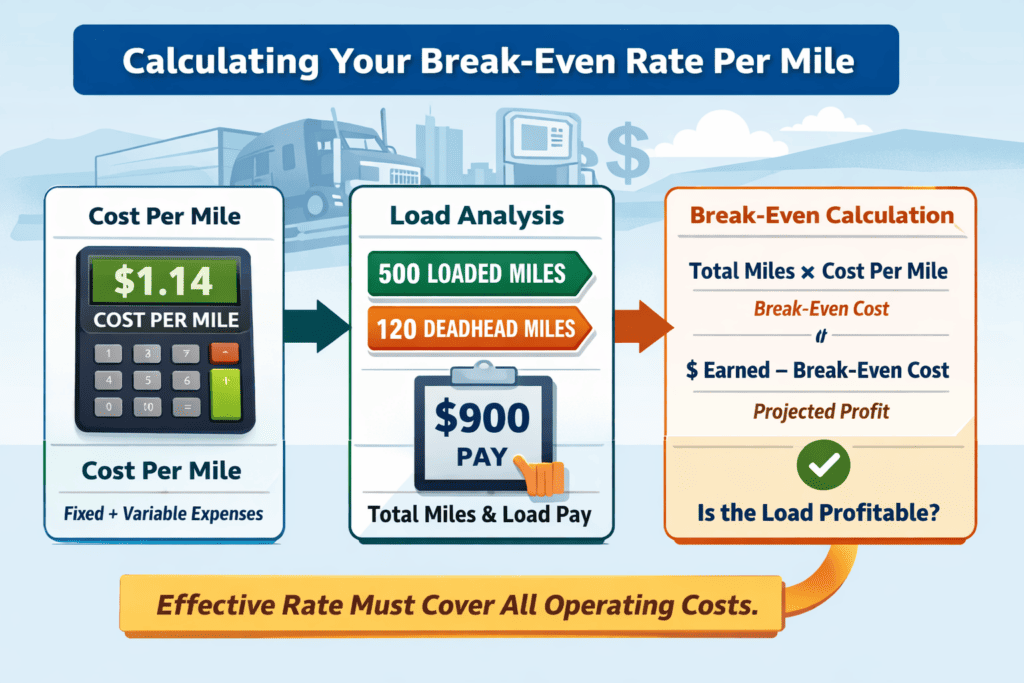
Assume your fully calculated cost per mile is:
$1.14 per mile
(including maintenance reserve and unpaid time allocation)
Now evaluate a real load:
• 500 loaded miles
• 120 unpaid deadhead miles
• $900 total pay
Total miles driven: 620
Effective rate per total mile: $900 ÷ 620 = $1.45
Your break-even requirement:
620 × $1.14 = $706.80
Projected margin:
$900 – $706.80 = $193.20
On paper, that is profit.
But now factor:
• Two hours of unpaid detention
• Slight fuel increase
• A slow reload market
That $193 margin compresses quickly.
Break-even protects survival.
Margin protects stability.
How Deadhead Miles Increase Your Owner-Operator Break-Even Rate
Unpaid repositioning miles are the most common distortion in break-even calculations.
Industry data consistently shows small carriers often operate with 15-25% empty miles. In expedited markets, repositioning can exceed that depending on lane imbalance.
Every unpaid mile raises the effective rate you need on loaded freight to remain profitable.
For a deeper breakdown of how deadhead erodes weekly income, see: 2026’s Empty Miles Crisis: How to Reduce Deadhead Before It Drains Your Paycheck
Ignoring deadhead is the fastest way to underestimate your real break-even rate.
Why Posted Rate Per Mile Often Falls Below Your Break-Even Rate
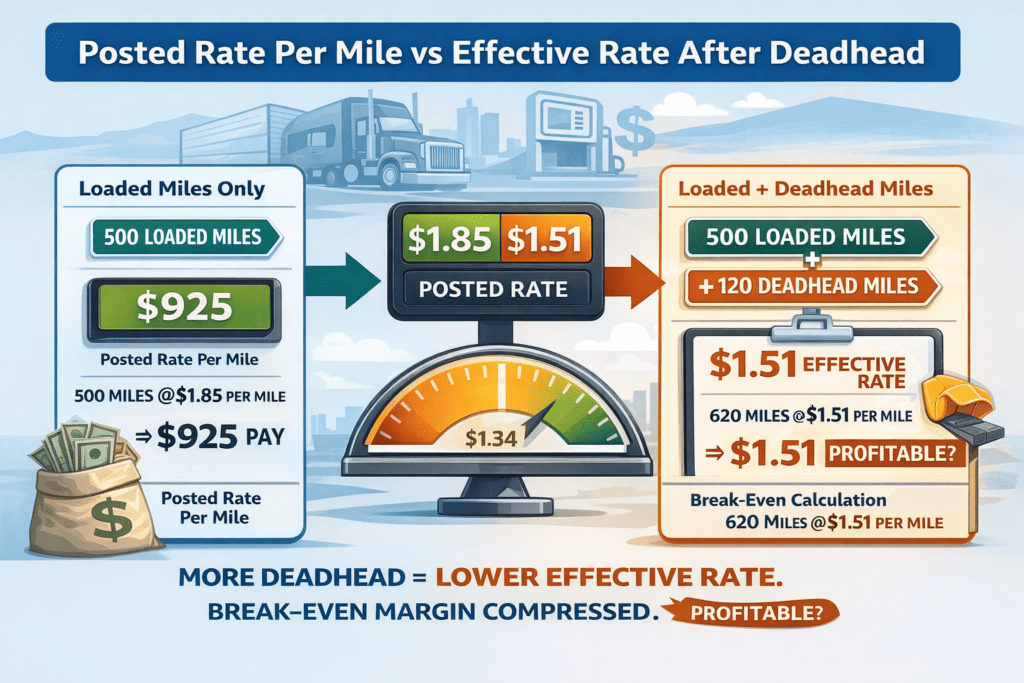
Load boards advertise loaded rate per mile.
Your truck operates on total miles.
A posted rate of $1.80 per mile can translate into:
$1.42 effective rate
after deadhead
after fuel
after unpaid delays
This explains why some operators run hard for 10,000 miles per month and still feel behind.
The issue is rarely movement.
It is margin compression inside acceptable-looking rates.
What Margin Above Break-Even Do You Actually Need?
Break-even is zero profit.
Experienced owner-operators typically aim for:
$0.20–$0.40 per mile above break-even
depending on equipment, region, and reload predictability.
That margin:
• Absorbs fuel swings
• Covers small delays
• Funds real maintenance
• Prevents reactive load acceptance
Without a buffer above break-even, one weak load forces two recovery loads.
That is how income volatility begins.
How Break-Even Discipline Stabilizes Weekly Owner-Operator Income
Your owner-operator break-even rate is more than a calculation. In practice, it becomes a behavioral constraint.
Operators who consistently apply break-even discipline make different decisions at the booking stage. They decline freight that sits too close to their operating floor, avoid unnecessary repositioning that inflates effective cost per mile, and prioritize lanes with stronger reload probability. Over time, those decisions produce more predictable weekly gross.
The cumulative effect is visible at the end of the month. Margins remain intact not because rates are always high, but because weak freight is systematically filtered out.
For a detailed breakdown of realistic weekly and annual owner-operator earnings by equipment type, see:
How Much Do Owner Operators Make in 2026?
Break-even discipline does not guarantee exceptional weeks. It prevents structurally weak ones.
Break-Even Rate as a Load Decision Tool
Your owner-operator break-even rate should function as a practical screening mechanism before any freight is accepted.
When evaluating a load, the relevant question is not simply “What is the posted rate per mile?” It is whether the effective rate – after accounting for deadhead, fuel variability, and expected dwell time – remains comfortably above your calculated operating floor.
If the adjusted rate sits only marginally above break-even, the load offers little protection against disruption. Minor delays, reload imbalance, or small fuel shifts can eliminate the projected margin entirely. Loads that operate within that narrow buffer often contribute to income volatility over time.
Consistently stable operators apply a structured evaluation process before booking freight. That process combines break-even math with lane logic, reload probability, and margin thresholds.
For a systematic approach to load evaluation, review: The Box Truck Load Filter: How to Systematically Choose Freight That Pays
Break-even analysis identifies your floor. Load filtering determines whether the freight in front of you meaningfully exceeds it.
The Difference Between Running and Earning
High mileage does not guarantee strong earnings. Margin discipline does. Without a clearly defined owner-operator break-even rate, rate decisions remain reactive.
If you have defined your break-even rate and apply it consistently, the next variable becomes freight quality. Not all loads are structured the same. Some lanes support disciplined operators. Others rely on volume and thin margins.
ExpeditedJobs works with owner-operators who prioritize rate discipline over movement. If you are evaluating your next lane or looking for freight that aligns with a defined operating floor, review current opportunities here:
Frequently Asked Questions About Owner-Operator Break-Even Rate
What is a break-even rate per mile for an owner-operator?
A break-even rate per mile is the minimum rate required to cover all operating expenses, including fuel, insurance, truck payments, maintenance, permits, deadhead miles, and driver labor. Any rate below this number results in operating at a loss.
How do I calculate my trucking break-even rate?
First calculate your full cost per mile, including maintenance reserves and unpaid miles. Then apply that number to total miles driven (loaded plus deadhead). Your break-even rate must exceed that total cost per mile to generate profit.
Is break-even rate the same as cost per mile?
No. Cost per mile reflects your operating expense baseline. Break-even rate applies that cost to a specific load and determines the minimum rate required to avoid losing money.
What margin should an owner-operator aim for above break-even?
Most experienced operators target $0.20-$0.40 per mile above break-even to absorb fuel volatility, unpaid time, and maintenance variability.
Why do some loads look profitable but aren’t?
Many loads appear profitable when calculated using loaded miles only. Once deadhead miles, fuel fluctuations, and unpaid delays are included, the effective rate often falls near or below break-even.

Table of Content
- What Is an Owner-Operator Break-Even Rate?
- How to Calculate Your Break-Even Rate Per Mile
- How Deadhead Miles Increase Your Owner-Operator Break-Even Rate
- Why Posted Rate Per Mile Often Falls Below Your Break-Even Rate
- What Margin Above Break-Even Do You Actually Need?
- How Break-Even Discipline Stabilizes Weekly Owner-Operator Income
- Break-Even Rate as a Load Decision Tool
- The Difference Between Running and Earning
- Frequently Asked Questions About Owner-Operator Break-Even Rate