


Cash flow in trucking rarely breaks because of rate. It breaks because of timing.
Two owner-operators can haul identical freight under the same broker, operate under identical net-30 agreements, and submit invoices on the same day – yet one sees payment in 12 days while the other waits 34.
The difference isn’t random.
It’s embedded inside broker payment terms for owner-operators – not just the written contract, but the operational system behind it.
Understanding how broker payment terms for owner-operators actually function is one of the most practical ways to stabilize weekly gross and reduce dependency on factoring.
How Broker Payment Terms for Owner-Operators Work
Standard broker payment terms for owner-operators are:
- Net-15 (less common)
- Net-30 (industry standard)
- Net-45 (higher-risk agreements)
The payment clock usually begins after invoice approval – not delivery – which explains why effective payment cycles vary.
Most broker payment terms for owner-operators are structured as net-30. Some brokers operate on net-15. A smaller portion extends to net-45.
But “net-30” does not necessarily mean 30 days from delivery.
In many brokerage accounting systems, the payment clock begins only after:
- The invoice is submitted correctly
- The proof of delivery is verified
- Accessorial documentation is approved
- No disputes are pending
If any element requires clarification, the invoice moves into manual review. When that happens, effective payment timing extends – even though official broker payment terms remain unchanged.
This is why two carriers operating under identical net-30 contracts may experience very different outcomes.
Payment timing is not just about the contract. It is about administrative friction.
Why Do Some Owner-Operators Get Paid in 10–14 Days?
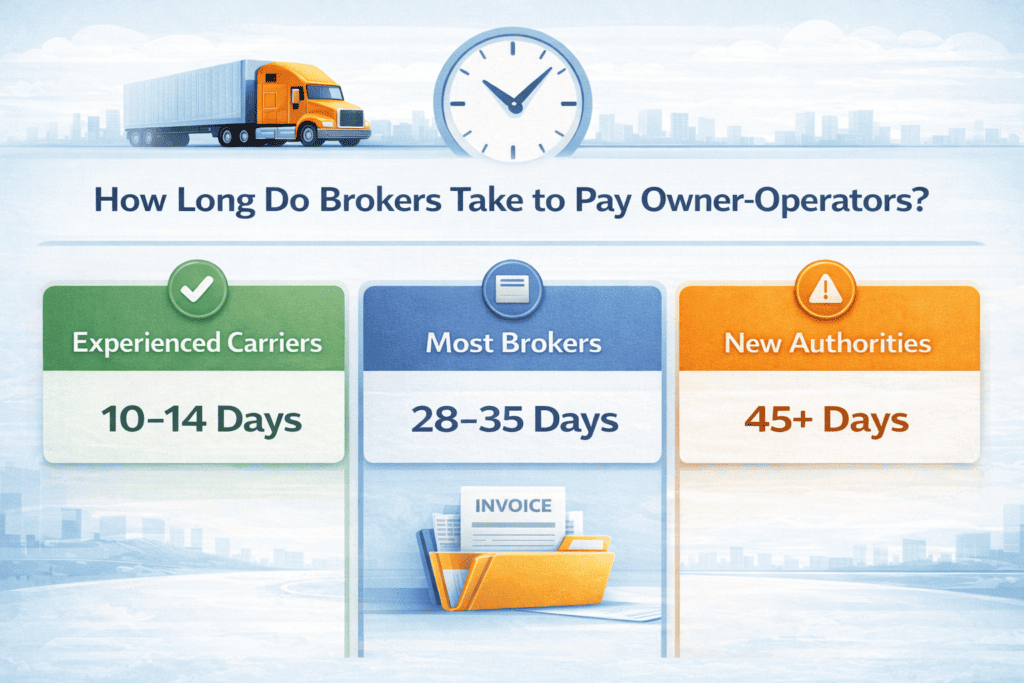
Industry averages suggest most brokers pay between 28-35 days. Yet many established carriers consistently receive funds in 10-14 days without enrolling in quick pay programs.
Why?
Because broker payment terms for owner-operators are shaped by internal trust scoring.
Over time, brokers build performance history on each MC number. Certain signals reduce perceived risk:
- Clean claims history
- Consistent on-time delivery
- Stable insurance records
- Minimal invoice corrections
- Low dispute frequency
When an accounting team recognizes an MC as predictable, invoices move through the system faster.
Less scrutiny equals faster release.
The carrier isn’t receiving different payment terms on paper – but they are experiencing different effective payment timing in practice.
Infographic showing how long brokers take to pay owner-operators: 10–14 days for experienced carriers, 28–35 days for most brokers, and 45+ days for new authorities.
Why Are Broker Payment Terms Slower for New MC Authorities?
New authorities often experience slower processing, even when official broker payment terms for owner-operators are net-30.
This is structural risk management.
A new MC number carries no internal performance record. Brokers cannot evaluate documentation habits, communication style, or dispute history. In a market that has seen increased cargo fraud and compliance violations, unfamiliar carriers automatically trigger higher oversight.
That same logic explains why some brokers hesitate to work with new authorities in the first place – a dynamic explored in detail here: Why Brokers Reject New MC Authorities
Payment timing improves as clean load history accumulates. Trust builds through repetition.
Net-30 vs. Effective Payment Cycle: What Owner-Operators Need to Understand
One of the biggest misconceptions about broker payment terms for owner-operators is assuming that net-30 applies equally to everyone.
In reality, there is a difference between:
- Stated payment terms
- Effective payment cycle
- Quick pay eligibility
- Payment holds triggered by disputes
Two carriers under identical net-30 agreements can experience dramatically different results.
If Carrier A consistently submits same-day PODs, clean invoices, and documented accessorials, their effective pay cycle may average 14 days.
If Carrier B frequently submits incomplete documentation or disputes detention without timestamps, their invoice may enter manual review – extending payment to 40 days.
Payment speed reflects operational confidence. And operational confidence compounds.
Carriers who prioritize structured freight relationships and work with reliable brokers tend to experience fewer administrative slowdowns.
Administrative Friction: The Hidden Cause of Payment Delays
Most payment delays are not intentional. They are procedural.
Common triggers that slow broker payment terms for owner-operators include:
- Late proof of delivery submission
- Rate confirmation discrepancies
- Missing lumper receipts
- Poorly documented detention claims
- Invoice formatting inconsistencies
Each issue interrupts automation. Automation pays quickly. Manual review extends timelines.
Experienced operators treat documentation as part of operations, not an afterthought. Rate confirmations are verified before departure. Detention is documented with in-and-out timestamps. PODs are submitted immediately upon delivery.
Reducing friction often shortens payment timing more effectively than paying quick pay fees.
Over time, that discipline also reduces reliance on factoring.
Quick Pay and Freight Factoring Under Broker Payment Terms for Owner-Operators
Many brokers offer quick pay options, typically paying within 2–7 days for a 1–5% fee.
Factoring operates similarly, converting receivables into immediate cash for a percentage cost.
For new authorities, these tools can be necessary. But long-term reliance reduces net margin. A 3% fee on $30,000 in monthly revenue represents more than $10,000 annually.
The broader cost structure and long-term implications are explored in: Freight Factoring in 2026
The goal isn’t eliminating quick pay entirely. It’s reducing how often it becomes necessary.
Carriers who stabilize relationships and access vetted loads for owner-operators often experience more predictable payment timing and fewer cash-flow shocks.
Why Payment Stability Matters More Than Rate Spikes
Many owner-operators optimize for rate per mile. But rate without payment reliability creates volatility.
A slightly lower-paying load paid in 14 days may create more operational stability than a higher-paying load paid in 35.
Broker payment terms for owner-operators shape working capital stability more than isolated CPM spikes.
Operators who prioritize:
- Repeat broker relationships
- Lane consistency
- Clean documentation
- Reduced disputes
Often experience smoother weekly cash cycles and lower factoring dependency.
That stability compounds over time.
If your goal is to reduce payment volatility and build predictable weekly gross, access to broker-approved loads becomes more important than chasing isolated spot market highs.
FAQ: Broker Payment Terms for Owner-Operators
How long do brokers take to pay owner-operators?
Most broker payment terms for owner-operators are net-30, meaning payment is issued approximately 30 days after invoice approval. However, actual payment timing can range from 10 to 45 days depending on documentation accuracy and carrier history.
Why do some owner-operators get paid in 10–14 days?
Established carriers with clean performance records often experience faster effective payment cycles because brokers process their invoices with less oversight and fewer manual reviews.
Can owner-operators negotiate faster broker payment terms?
In some cases, yes. Carriers with strong performance history and repeat lanes may negotiate shorter payment cycles or gain access to quick pay at lower fees. However, faster timing is typically earned through consistent performance rather than negotiated upfront.
Why do brokers delay payment?
Payment delays usually result from missing documentation, invoice discrepancies, detention disputes, insurance verification issues, or compliance reviews for new MC authorities.
Is quick pay worth it?
Quick pay can improve short-term liquidity but reduces overall profit margin. Improving documentation accuracy and broker trust often reduces the need for paid acceleration.
The Bottom Line
Broker payment terms for owner-operators are not just contractual details – they shape business stability.
When you reduce administrative friction, maintain performance consistency, and build repeat broker relationships, payment timing improves naturally.
If you’re ready to prioritize structured freight and predictable cash flow:
Because booking freight is only half the equation.
Getting paid – consistently and on predictable terms – is what turns revenue into a sustainable operation.
Work Out What the Wait Costs You Before You Accept the Terms
Payment terms are easy to argue about in the abstract and easy to settle with arithmetic. Three calculations below will tell you whether a broker’s terms are workable for your operation. Use your own numbers. The point is the shape of the math, not anyone else’s figures.
1. How much of your money is parked in unpaid invoices
Start with the number most operators already know: your average weekly gross. Call it G. If you invoice steadily and a broker pays on net-D terms, the amount of your own money sitting in unpaid invoices at any given moment is roughly:
Cash tied up = (G ÷ 7) × D
Divide your weekly gross by seven to get what you bill per day, then multiply by the payment term. On net-30 that comes to more than four weeks of revenue you have already earned and cannot spend. Fuel, insurance, and the truck payment do not wait thirty days, which is exactly how a profitable operation runs out of cash.
2. What shortening the wait is actually worth
Quick pay is quoted as a percentage of the load. Take the fee percentage F and the number of days it saves you, S:
Annualized cost of quick pay = (F ÷ S) × 365
A fee that looks trivial on one invoice gets expensive on an annual basis when it only buys back a few days, and it looks very different when it buys back most of a month. The same percentage can be a bargain or a bad deal depending purely on the terms it replaces, so run the multiplication before you decide which it is.
3. Your cash floor: the number that ends the argument
Add up everything that must leave your account in the next thirty days no matter what any broker does: truck note, insurance, permits, scheduled maintenance, and what you draw for your household. That total is your cash floor. If your cash on hand plus what you can realistically expect to collect does not clear it, the terms are not acceptable, whatever the rate per mile says.
That last one is a solvency question rather than a negotiating preference, and it is worth deciding at the kitchen table rather than on the phone with a broker. Operators who know their floor turn down terms calmly and specifically; operators who do not tend to accept whatever is offered and find out four weeks later what it cost.

Table of Content
- How Broker Payment Terms for Owner-Operators Work
- Why Do Some Owner-Operators Get Paid in 10–14 Days?
- Why Are Broker Payment Terms Slower for New MC Authorities?
- Net-30 vs. Effective Payment Cycle: What Owner-Operators Need to Understand
- Administrative Friction: The Hidden Cause of Payment Delays
- Quick Pay and Freight Factoring Under Broker Payment Terms for Owner-Operators
- Why Payment Stability Matters More Than Rate Spikes
- FAQ: Broker Payment Terms for Owner-Operators
- The Bottom Line
- Work Out What the Wait Costs You Before You Accept the Terms