



For many new owner-operators, the most confusing part of the first few months is not finding freight – it’s understanding why certain loads are never offered in the first place. A carrier may have a clean truck, valid insurance, and years of driving experience, yet still hear the same response from brokers: “We can’t use a new authority yet.”
The reason is simple. Brokers don’t evaluate a new MC authority based only on equipment or driver skill. They evaluate risk, and the first 60-90 days of a new authority represent the highest-risk period from their perspective.
How brokers evaluate a new MC authority
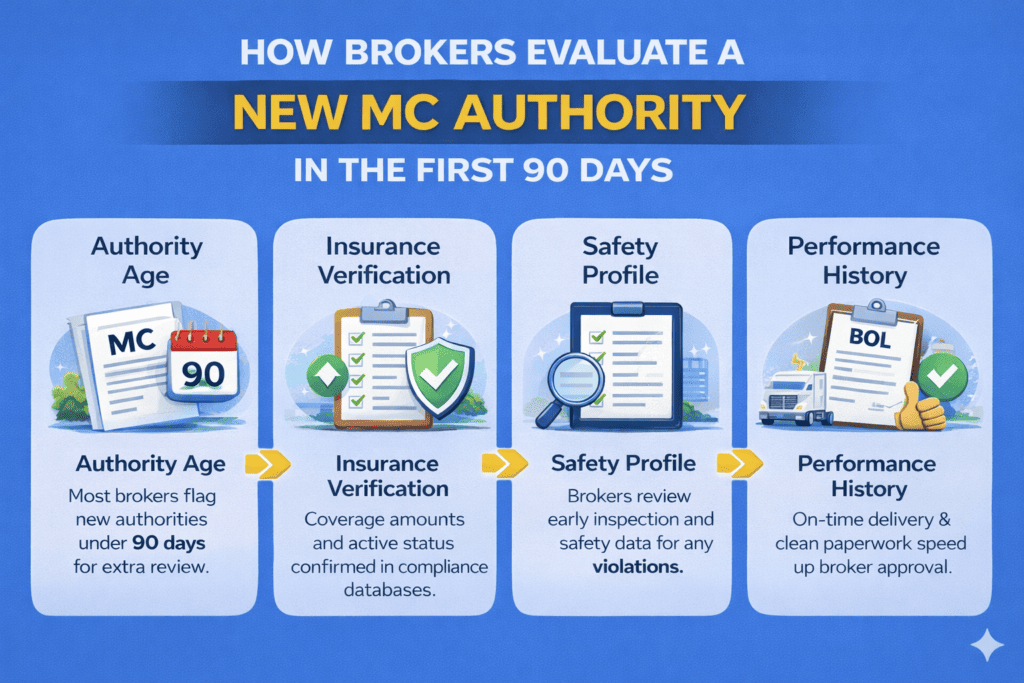
Brokers evaluate new MC authorities primarily based on authority age, insurance verification, safety profile, and early service performance. Most new carriers face additional review during the first 60–90 days because the authority has no completed load history. Completing early loads successfully, maintaining clean paperwork, and demonstrating on-time performance are the fastest ways to gain broker approval and access better freight.
What Brokers Check First When Evaluating New Carriers
When a broker receives a call from a new carrier asking about a load, the evaluation often happens in seconds. Most decisions are based on three primary factors: authority age, safety profile, and insurance coverage.
Authority age is usually the first filter. Many brokerage systems automatically flag carriers with authorities under 60 or 90 days. Some brokers will still work with them, but many larger brokerages have internal policies requiring a minimum authority age before approval.
Many broker onboarding platforms such as RMIS, SaferWatch, and Carrier411 automatically flag authorities under 60–90 days old, requiring additional manual approval before loads can be assigned. During this early period, carriers may still be approved for certain shipments, but access to higher-priority freight is often limited until the authority builds operating history.
Next comes the safety profile. Even if the authority is new, brokers still review available safety data, inspection records, and any early violations. A clean early record builds trust quickly, while even minor issues can slow approval.
Finally, brokers confirm insurance details. Coverage amounts, active status, and carrier ratings all influence approval decisions.
Most brokers also require standard minimum coverage levels, commonly $1 million in auto liability insurance and $100,000 in cargo coverage, before activating a carrier profile inside their systems. If coverage information has not yet synchronized across compliance databases, temporary onboarding delays can occur even when the policy is active.
Why New Authorities Get Rejected Even With Experience
Many new owner-operators assume prior driving experience should automatically translate into broker confidence. In practice, brokers evaluate the authority, not the driver’s résumé.
From a broker’s perspective, the MC number represents a business entity with no completed load history, no service track record, and no billing reliability record. Even experienced drivers appear “unknown” when operating under a new authority.
That uncertainty creates financial risk. Because of that exposure, many brokers initially limit the number of loads offered to new authorities or reserve certain lanes only for established carriers.
How Carrier Scoring Systems Affect Broker Approval
Many brokers rely on internal carrier-scoring systems that evaluate multiple data points simultaneously, including authority age, safety records, insurance verification, completed loads, claims history, and billing consistency.
In many brokerage environments, the first several completed loads have a disproportionate impact on a new carrier’s internal performance score. Consistent on-time delivery, clean paperwork submission, and successful billing during the first 30-60 days can significantly accelerate approval status across broker networks.
Why Some Loads Are Available to New MCs – and Others Aren’t
Not all freight is screened equally. High-risk or time-sensitive shipments are usually reserved for carriers with established performance records, while lower-risk freight is more often offered to new authorities. As the authority builds history, the range of available freight gradually expands.
How New MC Authorities Gain Broker Approval Faster
The fastest way for a new MC authority to expand freight access is to focus on consistency, not volume. Completing early loads on time, maintaining communication, and submitting clean paperwork builds credibility quickly inside broker systems.
In practice, this means focusing on a small number of clean, on-time deliveries, which is why many new carriers follow a first 10 broker-approved loads strategy to move out of the rejection phase faster.
Key Takeaways for New MC Authorities
- Brokers prioritize authority age, insurance coverage, and safety records when evaluating new carriers.
- Many onboarding systems automatically flag authorities under 60-90 days old for additional approval.
- Completing early loads successfully is the fastest way to improve carrier approval scores.
- Consistent communication and clean paperwork accelerate broker trust.
- Most new carriers see significantly improved freight access after the first 60-90 days of operating history.
For a step-by-step operational roadmap covering the first weeks of running a new authority, see how to find loads in your first 30 days without getting burned.
FAQ: Broker Approval for New MC Authorities
How long does it take for brokers to approve a new MC authority?
Many brokers begin approving new carriers within the first few weeks, but broader access to freight usually improves after 60-90 days of completed load history.
Why do brokers reject a new MC authority?
Brokers often reject new authorities because the carrier has no performance history, which increases service and financial risk.
What insurance is required for broker approval?
Most brokers require $1 million auto liability insurance and $100,000 cargo coverage before activating a new carrier profile.
How can new carriers get approved faster?
New carriers gain approval faster by completing early loads successfully, maintaining accurate paperwork, communicating consistently with brokers, and avoiding service failures during the first months.
The First Months Are About Credibility, Not Speed
New owner-operators often feel pressure to move as much freight as possible immediately after activating their authority. In reality, the early phase of a new MC authority is less about maximizing miles and more about building credibility. Each completed load strengthens the carrier’s operating history and gradually opens access to stronger freight opportunities.
Because in the freight market, trust is built load by load – and the first weeks of a new authority determine how quickly that trust develops.
Ready to start building your broker track record?
If you’re preparing to run your first loads under a new authority, the next step is working with freight opportunities that allow you to build clean performance history and strengthen broker approval across networks. You can explore structured owner-operator load opportunities and begin establishing the delivery record that opens access to stronger lanes over time.

Table of Content
- How brokers evaluate a new MC authority
- What Brokers Check First When Evaluating New Carriers
- Why New Authorities Get Rejected Even With Experience
- How Carrier Scoring Systems Affect Broker Approval
- Why Some Loads Are Available to New MCs – and Others Aren’t
- How New MC Authorities Gain Broker Approval Faster
- Key Takeaways for New MC Authorities
- FAQ: Broker Approval for New MC Authorities
- The First Months Are About Credibility, Not Speed
- Ready to start building your broker track record?


