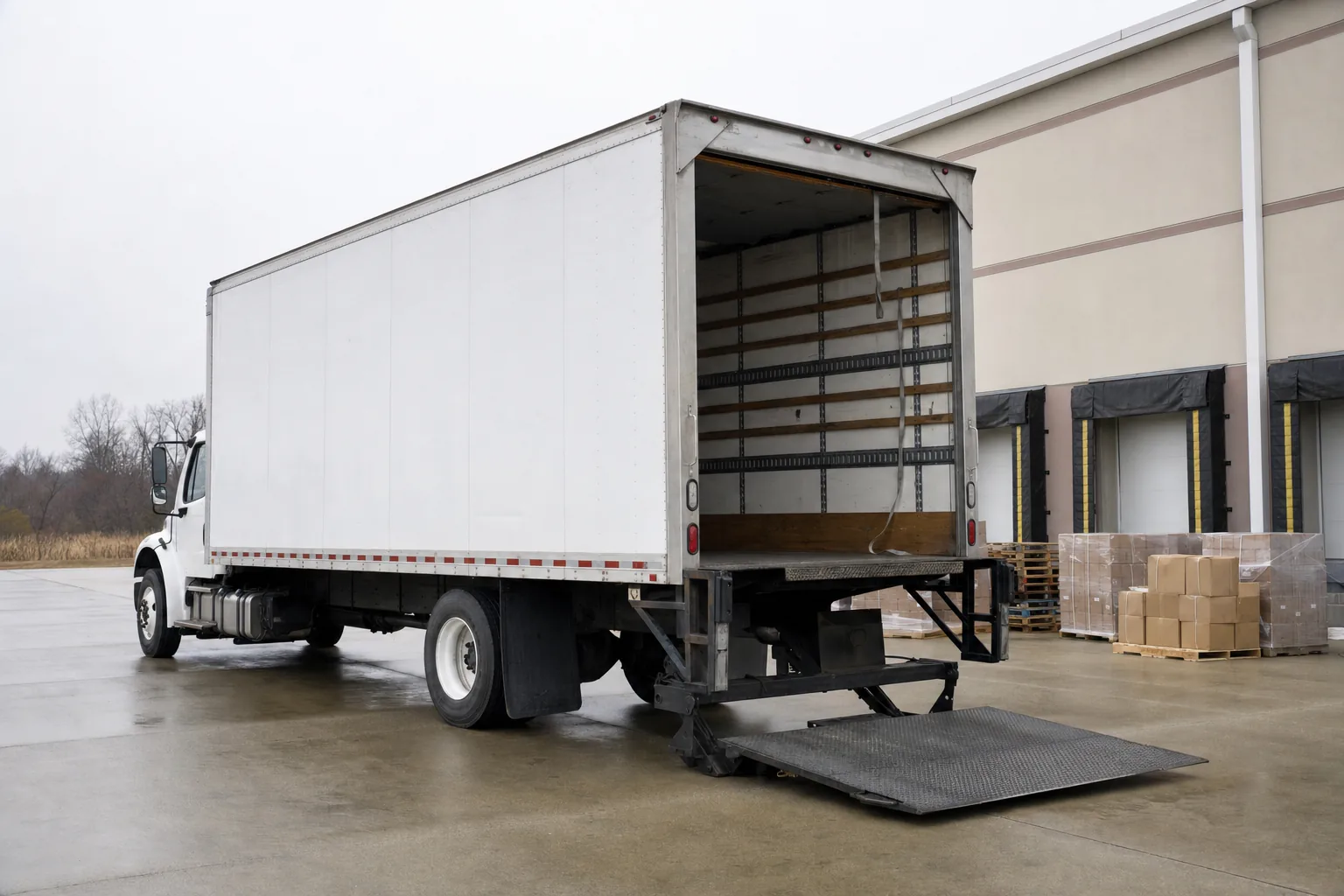



The 6 Months Cliff
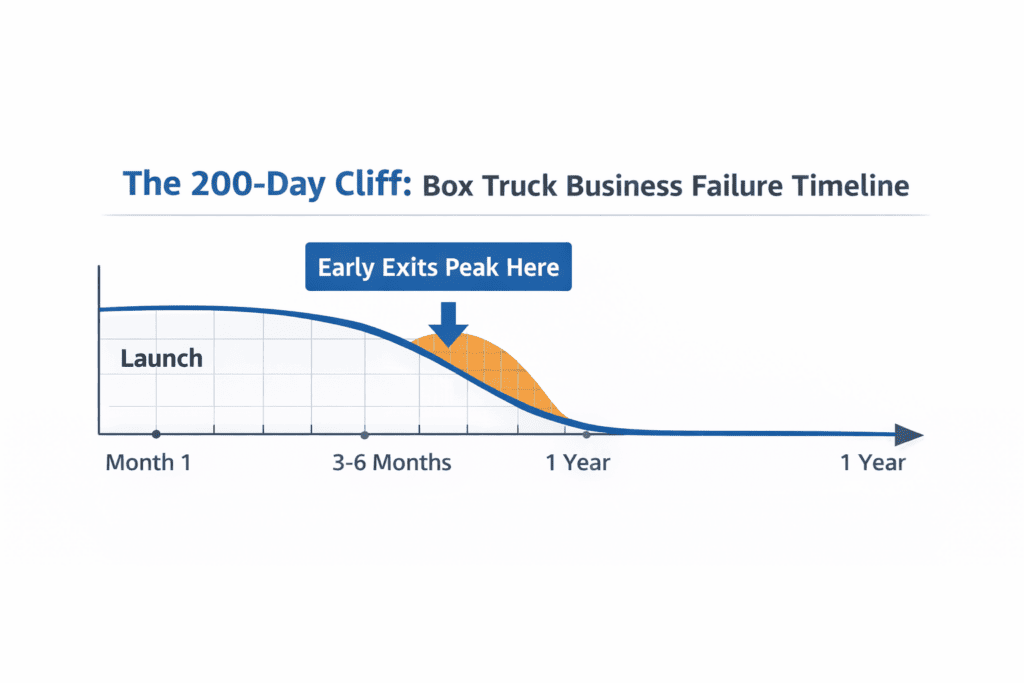
Across the U.S. small-carrier market, box truck business failure exhibits a distinct and repeatable pattern: a disproportionate number of new box truck owner-operator ventures cease operations within their first six months. This early attrition is observable in insurance cancellations, authority revocations, equipment liquidations, and inactive operating entities. The concentration of exits within roughly 200 days indicates a structural problem rather than random misfortune.
This report addresses a central analytical question relevant to lenders, investors, and risk committees: why box truck business fail so quickly after launch. Is the cause primarily external – market volatility, freight cycles, or fuel prices – or internal, rooted in identifiable and repeatable operational and financial errors?
The evidence supports a clear conclusion. Early failure is rarely the result of insufficient demand or lack of effort. Instead, it is driven by a predictable sequence of financial miscalculations and operational inefficiencies centered on a flawed understanding of unit economics. These errors compress margins from inception, leaving new ventures unable to absorb routine variability in costs or operations.
In practical terms: most box truck businesses don’t run out of work – they run out of cash because the math behind each mile is wrong from the start.
Failure Rate Context: Early Attrition as a Structural Outcome
Macro-level business survival data provides essential context for assessing box truck ventures. According to datasets published by the U.S. Bureau of Labor Statistics, approximately 25%of new trucking and transportation businesses fail within their first year. Comparable figures are cited by the Small Business Administration when tracking small-business survival across transportation subsectors.
While these figures encompass the full year, industry observers consistently note that a significant portion of failures occur well before the twelve-month mark. The timing matters. Businesses that fail within six months typically do not do so after prolonged exposure to adverse conditions; they exhaust initial capital while operating under a structurally unviable economic model. This distinction is critical for credit assessment and risk underwriting, as it points to design flaws rather than execution drift.
Box Truck Operating Costs and the Fundamental Miscalculation of Unit Profit
Gross Revenue Bias vs. Economic Reality
The most common and consequential error underlying early-stage failure is the misinterpretation of box truck operating costs. Many new ventures plan around gross revenue targets – weekly or monthly totals – rather than net profit per mile. This approach obscures the relationship between revenue and the actual cost structure of operating a box truck.
Operators who avoid this trap typically work inside box truck owner-operator jobs that emphasize repeatable lanes and predictable operating costs, rather than pure spot-market volume.
The authoritative benchmark for this analysis is published annually by the American Transportation Research Institute (ATRI) in its Operational Costs of Trucking report. For small fleets and owner-operators, ATRI identifies an average operating cost of $2.26 per mile. This figure represents the fully burdened cost of operation, including fuel, maintenance, tires, insurance, depreciation, permits, and overhead.
This benchmark defines the economic floor of viability. Any operation consistently generating revenue below this cost per mile box truck threshold is not profitable, regardless of gross receipts.
Plain English: if a truck earns less per mile than it costs to operate, every mile driven quietly burns cash – even if the weekly gross number looks good
A typical spot-market transaction illustrates the disconnect:
- Gross load revenue: $800
- Loaded distance: 300 miles
This is why many loads that “feel profitable” are actually break-even or negative once real operating costs are counted.
On a revenue basis, the transaction appears viable. When evaluated against the ATRI benchmark, the calculation changes:
- Operating cost: 300 miles × $2.26 = $678.00
- Net contribution: $800 − $678.00= $122.00
alt text: Visual breakdown showing how $800 box truck load revenue is reduced by operating costs to a $122 net profit.
In many cases, once all costs are correctly allocated, the remaining margin is negligible or negative. Loads that appear profitable in isolation are revealed to be break-even or loss-making when measured against true unit economics. Repeated across dozens of loads, this miscalculation produces predictable capital depletion.
This misunderstanding of unit profit is a primary driver of early box truck business failure, as it leads operators to scale activity that does not generate economic surplus.
Why Box Truck Business Fail: Deadhead as a Compounding Operational Tax
Deadhead Exposure and Box Truck Owner Operator Mistakes
Beyond cost miscalculation, operational inefficiency – specifically deadhead miles – represents the second major failure vector. Industry analysis indicates that box trucks operating predominantly on the spot market regularly experience deadhead rates approaching 30%.
In effect, empty miles don’t just reduce income – they raise the cost of every paid mile that follows.
Deadhead miles do not proportionally reduce costs. Fuel consumption, maintenance wear, depreciation, and time accrue regardless of load status. As a result, deadhead increases the effective cost per paid mile, not the nominal CPM.
The relationship can be expressed as:
Effective CPM = (ATRI CPM) ÷ (1 − Deadhead Rate)
Using illustrative placeholders:
- ATRI CPM: $2.00
- Deadhead rate: 30%
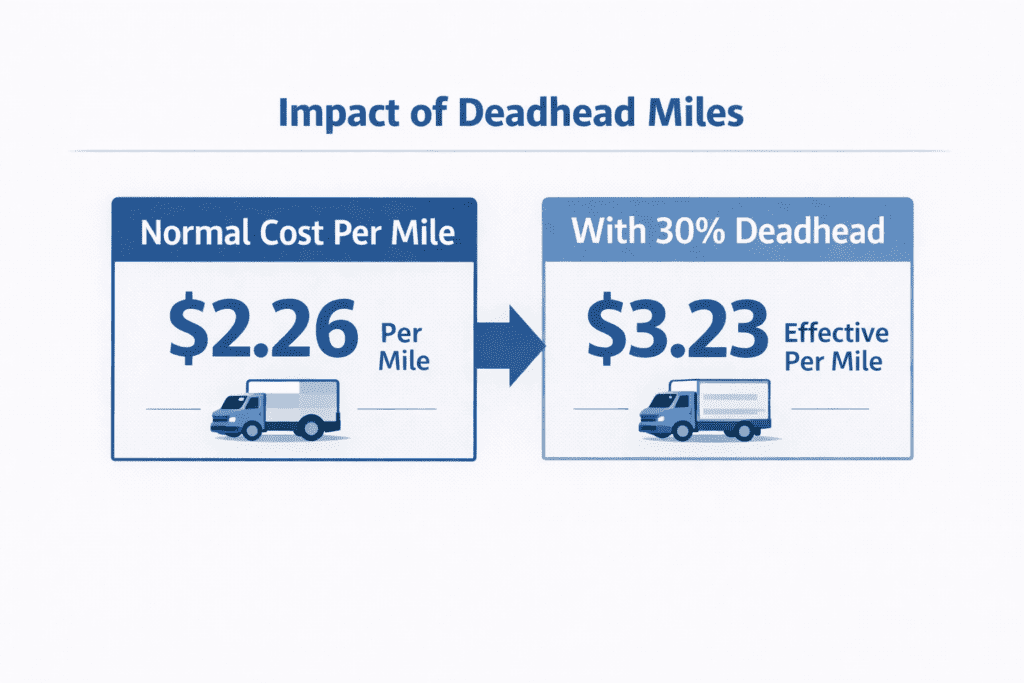
The effective cost per paid mile rises to approximately $2.86. This adjustment is decisive. A load paying $2.40 per mile may appear acceptable when compared to nominal CPM, yet becomes structurally loss-making once deadhead is correctly allocated.
This is the hidden reason many operators work harder, drive more, and still fall behind financially.
Persistently high deadhead is not a tactical inconvenience; it is a strategic failure. Treating deadhead as unavoidable or incidental is one of the most damaging box truck owner operator mistakes. Without lane discipline, freight alignment, or systematic matching, deadhead functions as a compounding tax that renders profitability mathematically unattainable at prevailing spot rates.
The Illiquidity Event: Unscheduled Maintenance as a Terminal Crisis
Under-Capitalization and Predictable Failure
The third critical failure point is under-capitalization in the face of routine mechanical risk. Industry maintenance data indicates that an unscheduled repair for a medium-duty truck averages $5k. This figure reflects direct repair costs only and excludes secondary effects such as towing, expedited parts, or opportunity cost.
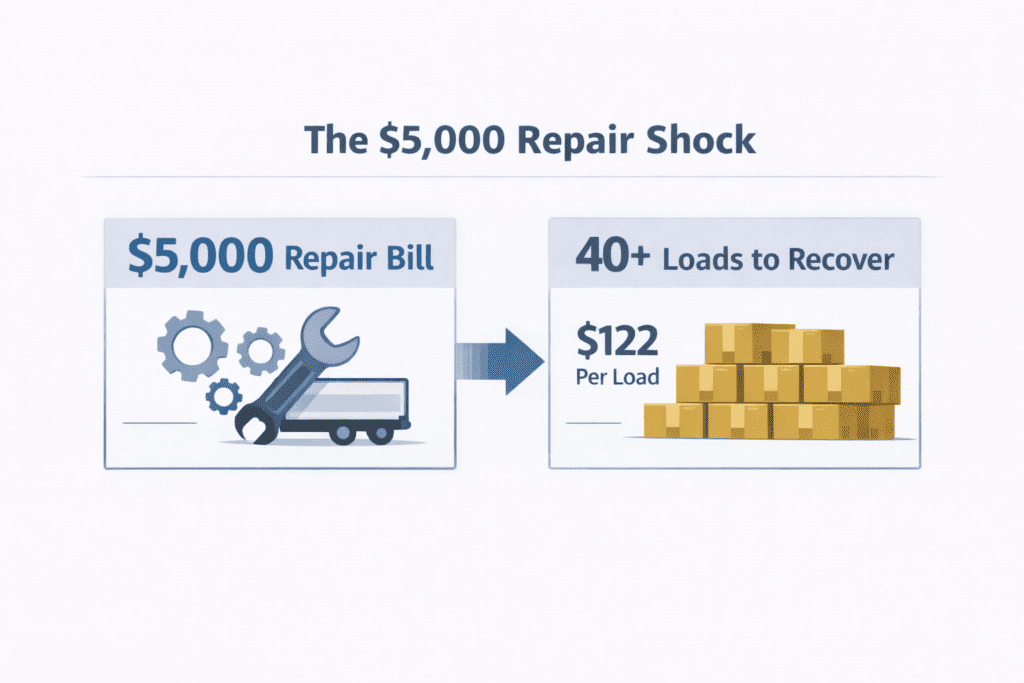
From a cash standpoint, one major repair can undo months of thin-margin operation almost instantly.
From a financial standpoint, the impact is twofold:
- Immediate cash outflow to fund the repair.
- Revenue interruption during downtime, while fixed costs – insurance, financing, and overhead – continue to accrue.
For ventures operating near break-even due to flawed cost modeling and high deadhead exposure, this repair cost often exceeds cumulative net profit generated in prior months. The result is rapid insolvency triggered by an event that is statistically inevitable over any meaningful operating horizon.
Importantly, this outcome is not caused by mechanical failure itself but by the absence of a dedicated maintenance reserve. Treating repairs as contingencies rather than as inevitable operating expenses is a foundational planning error that directly contributes to box truck business failure.
When no reserve exists, a routine mechanical event becomes a business-ending one.
The Predictable Failure Equation
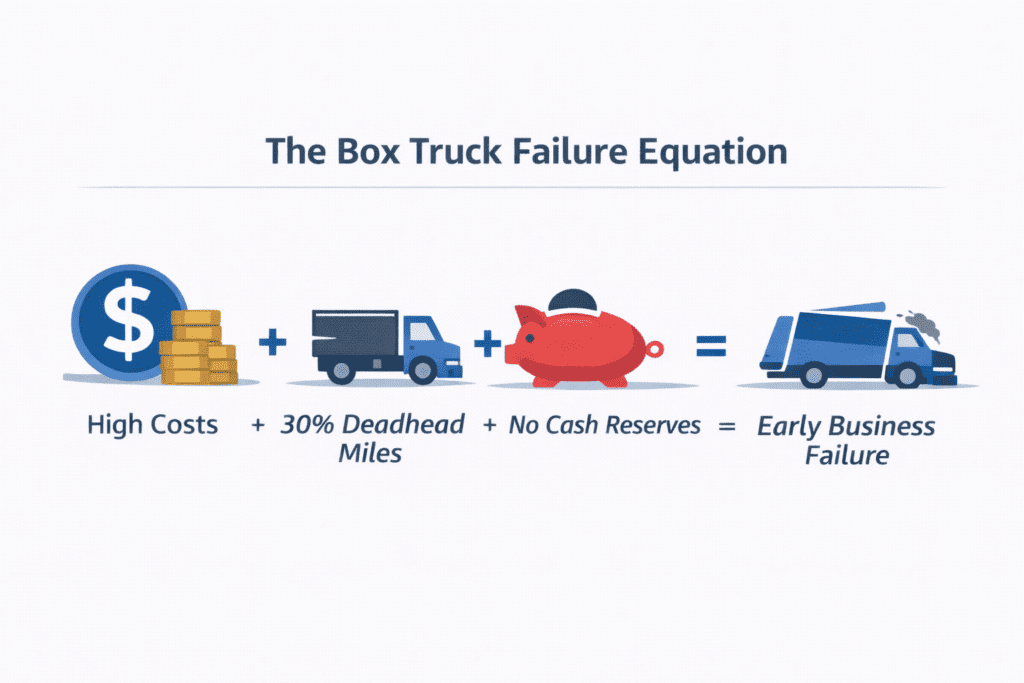
When examined collectively, early box truck failures resolve into a simple and repeatable equation:
(Misunderstood Cost Per Mile Box Truck Economics)
+ (High Deadhead Exposure)
+ (Insufficient Capital Reserves)
= Insolvency Within 200 Days
Each factor independently compresses margins. Together, they create a structurally unsound business model incapable of absorbing routine variability. None of these variables are random or external; all are measurable, predictable, and correctable at the planning stage.
The Path to the Minority That Succeeds
The minority of box truck ventures that persist beyond their first year do not do so through favorable timing or extraordinary effort. They succeed because they operate under a different financial discipline.
Durable operations consistently exhibit three characteristics:
- Accurate unit economics, anchored in authoritative benchmarks for true operating costs.
- Systematic deadhead reduction, achieved through lane consistency and aligned freight sourcing rather than opportunistic spot transactions.
- Non-negotiable capital reserves, treating maintenance liquidity as a fixed operating requirement.
In a market defined by thin margins, competitive advantage is not created by higher gross revenue. It is created by eliminating structural inefficiencies. Understanding these dynamics is central to how to succeed with box truck operations in a mature and competitive freight environment.
From an investor and lender perspective, the most resilient models are those engineered to directly mitigate the largest failure variable: deadhead. Platforms designed around intelligent freight matching and lane consistency materially improve unit economics and survival probability.
The businesses that survive are not the busiest – they are the ones where the numbers work consistently.
[Get Matched with Consistent, Low-Deadhead Loads]
Frequently Asked Questions
How long does it usually take before the problem becomes visible?
Later than the problem starts. The economics that end an operation are usually set in the first few weeks: the cost per mile that was calculated on gross revenue, the deadhead that was never counted, the reserve that was never funded. What arrives around the six-month mark is not the cause but the first event large enough to expose it, most often a repair that has to be paid before the next settlement lands.
Is it low rates that kill these operations, or costs?
Neither, in isolation. It is the gap between what the operator believes a mile costs and what it actually costs. An operator who knows their true number can survive a soft market by declining freight below it. An operator working from gross revenue cannot tell a profitable load from an unprofitable one, so a better market only means losing money faster.
How much cash should be in reserve before starting?
Work it out rather than picking a round figure. Two components: enough to cover your fixed monthly costs for the length of your longest expected payment term plus a margin, and enough to cover the single most likely major repair on your equipment without financing it. Ask a shop what that repair costs on your specific truck and mileage. A reserve that covers one but not the other is not a reserve. It is a delay.
Should deadhead miles go into my cost per mile?
Yes, and leaving them out is the most common version of the miscalculation described above. Costs accrue on every mile; revenue accrues only on loaded ones. If your cost per mile is calculated across total miles but your rate is evaluated against loaded miles, the two numbers are not comparable, and the error runs in the direction that makes bad loads look acceptable.
Can running more miles fix under-capitalization?
Only if each additional mile is genuinely profitable. If the unit economics are negative, more miles accelerate the failure while producing the appearance of a busy, growing business. That is why utilization alone is a poor health indicator: the operations that fail are frequently the ones that were running hardest.
What is the earliest warning sign?
Reaching for a credit card or a factoring advance to cover a routine, expected cost, like a tire, a service interval or an insurance instalment. Routine costs are supposed to come out of the reserve. When they start coming out of credit, the reserve does not exist, and the next unplanned repair becomes an event the business may not survive.

Table of Content
- The 6 Months Cliff
- Failure Rate Context: Early Attrition as a Structural Outcome
- Box Truck Operating Costs and the Fundamental Miscalculation of Unit Profit
- Why Box Truck Business Fail: Deadhead as a Compounding Operational Tax
- The Illiquidity Event: Unscheduled Maintenance as a Terminal Crisis
- The Predictable Failure Equation
- The Path to the Minority That Succeeds
- Frequently Asked Questions