



For many owner-operators, the day the MC authority goes active feels like the real beginning. The paperwork is done, insurance is bound, the truck is ready, and the assumption is simple: now the freight will come.
But in the actual market, the first 30 days under a new MC number are often the most fragile stretch of the entire business. Not because there are no new MC loads available, but because the freight offered to brand-new carriers is usually the freight everyone else declined.
Most new operators don’t fail because they can’t find owner-operator loads for a new authority. They fail because the loads they find quietly drain their time, their cash flow, and their margin. By the time the numbers catch up, the damage is already done.
Industry data supports this pattern. Federal Motor Carrier Safety Administration and Bureau of Labor Statistics figures consistently show that a large share of new trucking businesses fail within their first year. Many of those failures trace back to early operational decisions: weak lanes, poor broker relationships, unpaid time at shippers, or cash-flow gaps during the first month.
The first 30 days are less about growth and more about survival.
Quick reality check: what the first 30 days usually look like
For most new authorities, the early market behaves the same way:
- Brokers treat new MCs as higher risk.
- The available loads are usually cheaper or less structured.
- Deadhead is higher than average.
- Payment terms create cash-flow pressure.
This combination is what causes many new owner-operator businesses to struggle before they ever stabilize.
The invisible “new MC” penalty
In the first 60 to 90 days, a new MC number carries an invisible penalty in the freight market. Brokers don’t necessarily say it out loud, but they price risk into every decision.
From their perspective, a new carrier has no history, no performance record, and no proof of reliability. Even if the truck and the driver are experienced, the authority itself is untested. That uncertainty shows up in the types of loads offered.
In practice, this means the pool of owner-operator loads available to a new MC is smaller, cheaper, and often less structured than what established carriers see.
Established box trucks may regularly see freight in the $1.70 to $2.40 per mile range on decent lanes. A brand-new MC often sees the same equipment offered loads closer to $1.20 to $1.60 per mile. The difference isn’t about capability. It’s about perceived risk.
Many of these early limitations come from how brokers evaluate new carriers. Understanding how brokers evaluate new MC authorities can help you avoid early approval mistakes.
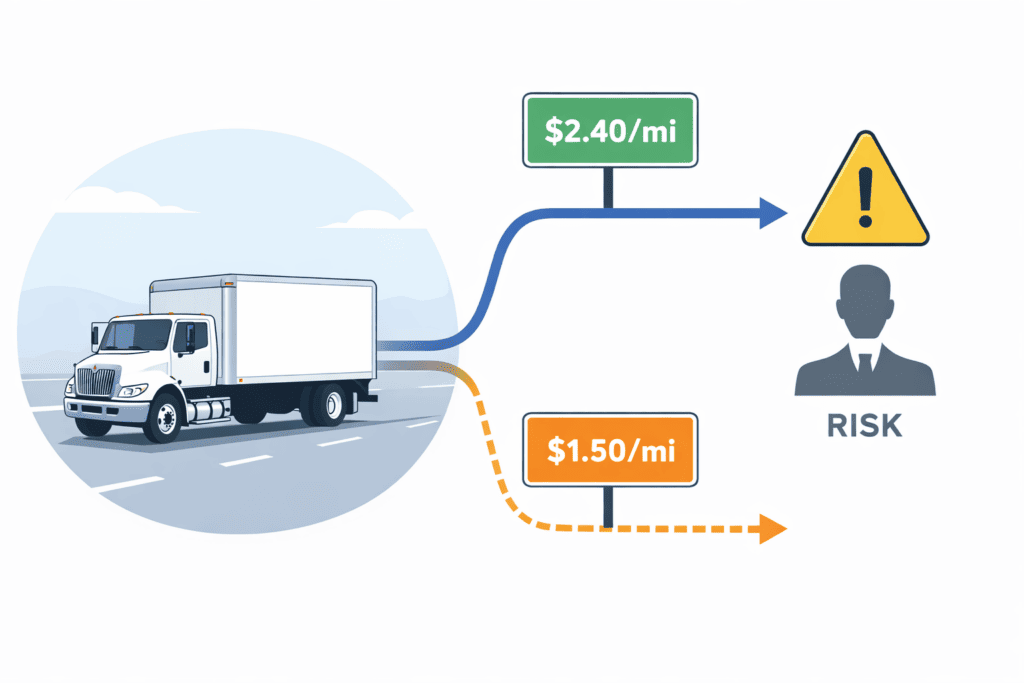
These are the typical new MC loads – freight that moves, but doesn’t always leave room for profit.
Operating costs, however, don’t drop just because the authority is new. According to the American Transportation Research Institute’s latest cost studies, marginal trucking costs commonly land between $1.70 and $1.90 per mile when fuel, maintenance, insurance, and overhead are included. Even in the box truck segment, many owner-operators report real operating costs in the $1.40 to $1.80 per mile range, depending on utilization and insurance premiums.
That means much of the freight available to a new MC is, at best, break-even. At worst, it quietly loses money while still keeping the truck busy.
And as many operators discover, the real cost per mile is often higher than expected in the first months.
And that’s where the first month starts to go wrong.
How a “decent” week turns into a bad one
Most early failures don’t come from one catastrophic decision. They come from a series of reasonable-looking loads that slowly chip away at the week.
A new operator books one of the first box truck loads available just to get moving. The pickup window is broad, and the truck ends up sitting three or four hours. Delivery drops in a weak freight market, forcing a long deadhead just to find the next load. The reload is cheap, but it keeps the wheels turning.
Nothing in that sequence looks disastrous on paper. The rates weren’t terrible. The miles made sense. The brokers sounded normal. But by the end of the week, the truck has moved thousands of miles and the revenue doesn’t reflect the effort.
DAT market data shows that average deadhead ratios often land around 15 to 20 percent. For new carriers, that number can easily climb to 25 or even 30 percent because they’re taking whatever loads for new authority appear first instead of choosing structured lanes.
That difference matters more than most new operators realize. If a truck runs 2,000 paid miles and 600 empty miles, the real operating cost isn’t based on 2,000 miles. It’s based on 2,600. The extra 600 miles are pure expense, and they can erase the margin from the entire week.


The cash-flow squeeze
The first month also exposes a problem that many new MCs underestimate: payment timing.
Most brokers still operate on net-30 or net-45 payment terms. Some stretch to net-60. That means a carrier can run multiple loads before seeing the first dollar hit the account.
A typical scenario looks like this: the truck grosses around $4,000 in week one, $4,200 in week two, and $3,800 in week three. On paper, that’s nearly $12,000 in revenue. In reality, the bank account may still be close to empty because the first payment hasn’t arrived yet.
Fuel, insurance, and maintenance don’t wait for net-30 terms. They come due immediately. That’s why many new carriers turn to factoring in their first month. But factoring usually costs between two and five percent of the invoice. If the new MC loads are already low-margin, that fee cuts even deeper into the profit.
The result is a business that looks busy but feels constantly short on cash.
How to get loads with zero operating history
One of the most common questions new carriers ask is simple: how do you get loads when your authority has no history at all?
In the early weeks, most brokers evaluate a new MC through a risk lens. They’re not just looking at the truck or the driver. They’re looking at the authority itself. With no completed loads, no service record, and no payment history, a new MC is an unknown.
That’s why many brokers:
- Decline new authorities outright
- Offer only lower-priority freight
- Require extra paperwork or references
In practical terms, the first loads usually come from:
- Brokers willing to work with new carriers
- Lower-risk, shorter runs
- Less competitive lanes
- Structured or dispatch-supported freight setups
The goal in this phase isn’t to chase the highest possible rate. It’s to complete clean loads, avoid service failures, and build a basic operating record. After several successful deliveries, the authority begins to look less risky, and the quality of available freight improves.
Why new trucking authorities struggle with cash flow
Cash flow is one of the biggest reasons new authorities fail in the first 90 days.
The problem isn’t always low revenue. Many new MCs generate decent gross numbers in their first few weeks. The issue is timing.
Expenses start immediately:
- Fuel is daily
- Insurance is monthly
- Maintenance is unpredictable
- Permits and compliance costs add up
But most freight revenue arrives:
- 30 to 45 days later
- Or sooner only with factoring fees
That gap creates a dangerous situation. A carrier can be running loads, generating invoices, and still be short on cash. If one repair, unpaid load, or slow broker enters the picture, the operation can stall quickly.
This is why experienced operators treat the first month as a cash-flow management phase, not a revenue-maximization phase.
Why new MCs make the same mistakes
The patterns are remarkably consistent across forums, dispatch offices, and broker feedback.
New operators tend to focus on movement instead of structure. The instinct is to keep the truck rolling at all costs, because sitting feels like losing money. In reality, a cheap load into a weak area can cost more than waiting a few hours for a better lane.
Time is also underestimated. Many new carriers evaluate freight purely on rate per mile or total payout. But the real cost includes waiting at the shipper, delayed appointments, extra labor, and the difficulty of finding the next load. A run that stretches across an entire day may pay less per hour than a shorter, lower-rate load that keeps the schedule tight.
Then there’s broker selection. In the first month, many new MCs accept loads from unfamiliar brokers with weak payment histories or poor reputations. One unpaid invoice in the first 30 days can destabilize the entire operation.
What a stable first month actually looks like
The first 30 days rarely produce record-breaking weeks. And they shouldn’t.
A healthy first month is usually defined by control, not excitement. The operators who survive tend to focus on consistency: predictable lanes, reasonable appointment windows, and brokers with reliable payment histories.
The goal isn’t to take every load that appears on the board. It’s to identify structured owner-operator loads that keep the truck in healthy lanes.
For a new box truck MC, a realistic target in the first month might be somewhere in the $3,500 to $4,500 weekly gross range, with roughly 1,800 to 2,400 loaded miles and deadhead kept under 20 to 25 percent. Those numbers may not look impressive next to the $6,000-plus weekly claims often seen online, but stability in the first month is what makes those larger weeks possible later.
Once a new MC completes clean loads, builds broker relationships, and establishes a performance record, the quality of available freight begins to improve. Rates become more negotiable. Lane options expand. But that transition only happens if the operation survives the early stage.
The real goal of the first 30 days
Many new owner-operators treat the first month like a sprint. They aim for the highest possible gross revenue, the longest runs, and the biggest numbers they can post.
Experienced operators take the opposite approach. They treat the first month as a stabilization phase.
The real priorities are simpler: avoid service failures, maintain cash flow, build broker trust, and learn which lanes actually produce consistent reloads. It’s less about proving the truck can run and more about proving the business can survive.
Because once the authority builds a track record, the environment changes. Brokers become more comfortable. Better owner-operator loads appear. Negotiations become easier. The early penalties start to fade.
But none of that happens if the first month is built on weak freight, unpaid time, and unstable cash flow.
Once those priorities are clear, the next step is execution, following a first-load strategy that helps new authorities complete their initial broker-approved shipments instead of guessing through random postings.
Structure over guesswork
This is why many new MCs choose structured, dispatch-supported setups during their first months instead of relying entirely on open load boards for random loads for new authority.
With the right structure, the early phase becomes more predictable and less exposed to risky brokers or poor lanes. Instead of guessing through every booking, the operator focuses on running consistent freight, learning the business rhythm, and building a stable operating base.
The first month decides the first year
In trucking, businesses rarely collapse because of one dramatic mistake. They collapse because of a series of small, acceptable decisions that slowly drain time and money.
A cheap load into a weak market.
A four-hour wait at a shipper.
A slow-pay broker.
A long deadhead for the next reload.
Each decision seems manageable in the moment. Together, they can end a business before it ever stabilizes.
The first 30 days under a new MC authority aren’t about chasing big numbers. They’re about protecting time, controlling risk, and building a foundation strong enough to last through the first year.
Starting a New MC and Need Structured Loads?
Many new authorities stabilize faster when their first loads are planned instead of guessed through load boards.
FAQ: New MC Loads and First-Month Survival
Is it hard to find loads with a new MC?
It’s usually not hard to find loads, but it is hard to find profitable, structured loads in the first 30 days. Many new MCs take freight that moves the truck but doesn’t protect the week.
How long does it take for a new MC to get better loads?
Most carriers see noticeable improvement after 60-90 days, once they have completed loads and built a basic performance history with brokers.
What are typical rates for new MC box truck loads?
Many new authorities see freight in the $1.20-$1.60 per mile range at first, depending on lane and urgency, while more established carriers often access higher-paying freight.
Should a new MC rely only on load boards?
Some do, but structured or dispatch-supported freight can reduce early mistakes and help stabilize cash flow during the first 30-60 days.

Table of Content
- Quick reality check: what the first 30 days usually look like
- The invisible “new MC” penalty
- How a “decent” week turns into a bad one
- Struggling to Find Stable Loads With a New MC?
- The cash-flow squeeze
- How to get loads with zero operating history
- Why new trucking authorities struggle with cash flow
- Why new MCs make the same mistakes
- What a stable first month actually looks like
- The real goal of the first 30 days
- Structure over guesswork
- The first month decides the first year
- Starting a New MC and Need Structured Loads?
- FAQ: New MC Loads and First-Month Survival


