


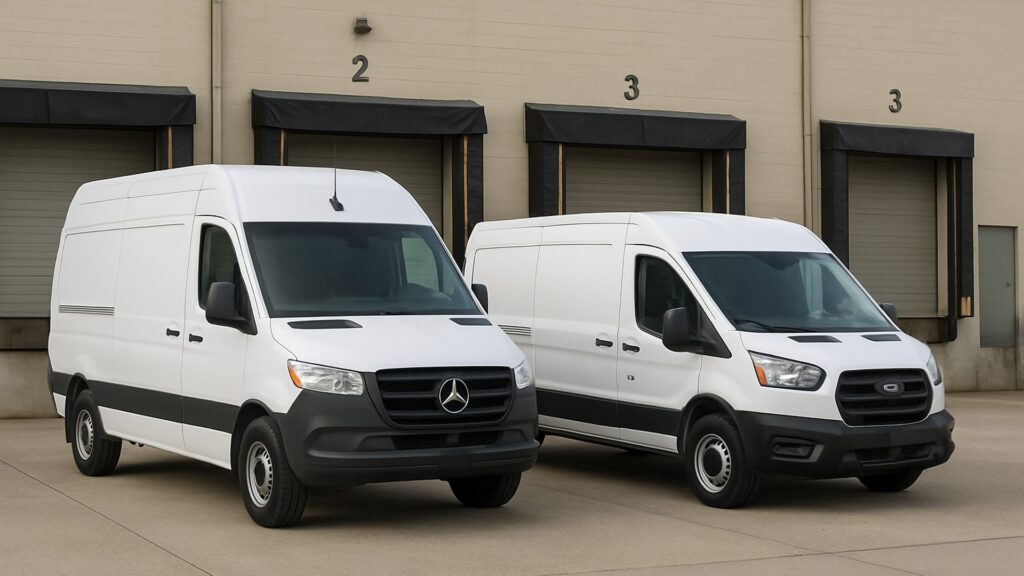
On paper, sprinter van pays more per mile. In practice, the cargo van often nets more per week. The rate isn’t the answer. The cost structure is, and the lane access is, and the freight type is. Comparing them on rate alone is the mistake most newer operators make when they’re picking the next vehicle.
The honest comparison in 2026 isn’t “which one pays more.” It’s “which one nets more for the freight you can actually book.” Those are different questions, and the answer flips depending on the operator’s lanes, market, and equipment setup. The American Transportation Research Institute’s 2025 Operational Costs of Trucking report shows the cost stack scaling more steeply than rates do as vehicle class steps up, which is the part of the math the rate-per-mile chart never includes.
What each vehicle actually carries
Cargo van in expedited freight typically means a Promaster 2500, Transit 250, or Sprinter 2500 in standard wheelbase. Cargo capacity sits around 250 to 300 cubic feet, payload 3,000 to 3,500 pounds, and load floor length around 130 to 140 inches. The freight is small-piece urgent: one to four skids, medical kits, automotive parts, document boxes, hot-shot LTL pickups.
Sprinter van in this segment usually means an extended-wheelbase Mercedes-Benz Sprinter 3500 with high roof, often with a 144 or 170-inch wheelbase. Cargo capacity is 380 to 530 cubic feet, payload 4,500 to 5,500 pounds, and load floor length 170 to 190 inches. The freight is larger-piece urgent: four to eight skids, larger machine parts, longer items, and freight that exceeds cargo van capacity but doesn’t justify a Class 6 truck.
The lane access difference comes from the cubic and the length, not the rate. A sprinter can take a 12-foot pipe section that won’t fit in a cargo van. A cargo van can squeeze into urban delivery points where a high-roof Sprinter doesn’t clear the dock height.
Rate per mile by freight type
| Freight type | Cargo van rate | Sprinter rate |
|---|---|---|
| Hot-shot LTL (1-2 skids) | $1.05-$1.25/mi | $1.20-$1.40/mi |
| Medical/biomedical (2-4 skids) | $1.20-$1.45/mi | $1.45-$1.75/mi |
| Automotive parts (regional) | $1.10-$1.30/mi | $1.35-$1.60/mi |
| Long-haul expedite (4+ skids) | $1.15-$1.35/mi | $1.50-$1.80/mi |
| Average loaded rate | $1.15 | $1.50 |
The sprinter wins on every line. The gap is roughly $0.30 to $0.40 per mile across the typical mix. That sounds like a clear answer until the cost side enters.
Cost structure comparison
The sprinter’s higher rate has to cover a higher cost stack. Most newer operators don’t run that math before they upgrade.
Fuel: cargo van runs 18 to 22 mpg on the Promaster/Transit gas platforms, 22 to 26 mpg on the Sprinter cargo van diesel. Sprinter 3500 high roof runs 18 to 22 mpg on diesel. The fuel cost per loaded mile is roughly $0.20 to $0.24 for cargo van gas, $0.16 to $0.19 for cargo van diesel, and $0.21 to $0.25 for sprinter 3500. Sprinter loses some of the rate gap to fuel.
Insurance: cargo van commercial premiums in 2026 run $7,500 to $11,000 a year. Sprinter 3500 premiums run $9,500 to $14,000 a year. The higher GVWR and replacement cost both push the premium up.
Maintenance: sprinter 3500 service intervals are similar to the cargo van, but parts and dealer labor are higher. Mercedes-Benz commercial diesel service runs 30 to 45 percent more per visit than Promaster or Transit. Annual maintenance reserve for cargo van is $4,500 to $6,000. For Sprinter 3500 it’s $6,500 to $9,500.
Vehicle cost: a used 2022 Promaster 2500 in the $25,000 to $32,000 range. A used 2022 Sprinter 3500 high-roof extended runs $42,000 to $55,000. Depreciation per loaded mile is roughly $0.13 to $0.15 for cargo van, $0.18 to $0.22 for Sprinter.
Net earnings comparison
An operator running 2,500 loaded miles a week.
| Line item | Cargo van | Sprinter 3500 |
|---|---|---|
| Average rate per mile | $1.15 | $1.50 |
| Weekly gross | $2,875 | $3,750 |
| Fuel | −$525 | −$575 |
| Insurance (prorated) | −$180 | −$240 |
| Maintenance reserve | −$110 | −$160 |
| Tolls + parking | −$80 | −$90 |
| Depreciation | −$350 | −$500 |
| Weekly net before tax | $1,630 | $2,185 |
| Annual net (50 weeks) | $81,500 | $109,250 |
The sprinter wins on net at the same loaded mileage. The gap is real, but smaller than the rate-per-mile gap suggests, and it depends on the operator actually getting 2,500 loaded miles a week, which is harder for the sprinter to hit consistently than for the cargo van.
Lane access
The cargo van wins on freight volume. There is more cargo van freight on the market than sprinter freight, because more shippers have the smaller-piece urgent moves than the longer-piece urgent moves. A cargo van operator with broker relationships can typically book 2,500 loaded miles a week with reasonable lane choice. A sprinter operator often runs 2,000 to 2,200 loaded miles a week because the freight pool is smaller and the lanes are more specific.
The math flips when the loaded miles drop. At 2,000 loaded miles a week, the cargo van still nets around $1,300, but the sprinter drops to roughly $1,750 once the higher fixed costs are spread over fewer miles. The sprinter still wins, but the gap closes from $555 a week to $450 a week, and the sprinter operator is working harder to find the freight.
The decision framework
The vehicle that nets more depends on three variables: the operator’s lane access, the operator’s tolerance for downtime, and the operator’s tolerance for capital tied up in the vehicle.
Cargo van wins when the operator is starting fresh with no broker relationships, when the lane mix is short-haul and regional, when the capital reserve is under $50,000, and when steady volume matters more than peak weeks.
Sprinter wins when the operator has 12 plus months of expedite history, established broker relationships, lanes that include long-haul or sprinter-specific freight (industrial parts, medical equipment, AOG aviation), and the capital to absorb the higher fixed costs through occasional slow weeks.
| Quick reality check |
| If your weekly loaded miles drop below 1,800, the sprinter’s higher fixed costs eat the rate advantage. |
| If you can’t name three brokers in your market who book sprinter-class freight, the rate per mile is theoretical. |
| If your vehicle reserve is under $50,000, the cargo van is almost always the right starter. |
The honest version
Sprinter pays more per mile and nets more per week at the same loaded mileage. Cargo van is easier to keep loaded, easier to insure, easier to maintain, and easier to start with. Most newer operators should run cargo van for 12 to 18 months before considering the sprinter step up, and most operators who skip that progression discover the sprinter’s higher fixed costs the hard way during their first slow month.
The decision isn’t sprinter or cargo van. It’s “which one fits the operation I can actually run today, and when does the upgrade make sense.” Year one rarely answers “yes” to sprinter, no matter what the rate-per-mile chart shows.
For operators starting from scratch in cargo van, the cargo van starter guide covers the equipment, authority, and earnings reality at the entry level. Comparing the two on paper only gets you so far; current sprinter and cargo van jobs show how the market values each one. If you already know the state you will be based in, the cargo van work is listed state by state: Texas, Georgia, North Carolina, Alabama.