

November 11, 2025
By Expeditedjobs
Nearly 200,000 truckers are facing uncertainty since the FMCSA’s new non-domiciled CDL rule abruptly took effect at the end of September.
The rule shut down the ability of many legally authorized drivers – including DACA recipients, asylum seekers, and others with valid work permits – to apply for or renew a CDL.
A lawsuit filed in federal court quickly challenged the regulation, arguing it unfairly sidelined safe, experienced drivers and ignored due process. Now, after weeks of filings and mounting pressure from driver groups, the D.C. Circuit Court of Appeals has stepped in – a move that could change everything for non-domiciled CDL holders.
So what’s changed? Can drivers finally renew or apply for their CDLs again? And what should they do next? Let’s break it down.
What the Rule Changed
In late September, the Federal Motor Carrier Safety Administration (FMCSA) issued an interim final rule that took effect immediately, limiting who could receive a non-domiciled CDL,
Under the rule, only the following categories qualified:
- U.S. citizens and lawful permanent residents, and
- three visa categories: H-2A, H-2B, and E-2.
The change meant that drivers with other types of lawful work authorization – such as DACA recipients, asylum seekers, or holders of Temporary Protected Status (TPS) – could no longer apply or renew.
At the same time, FMCSA ordered states to pause issuance and renewals of non-domiciled CDLs until they updated their systems to match the new restrictions.
Why FMCSA Says It Acted
In its official filings, FMCSA defended the rule as a safety measure, claiming that states cannot reliably verify the driving history of recent arrivals.
“There is no way to verify driving history of someone who recently came into the United States, and therefore it poses a safety risk,” – FMCSA response brief.
The agency said it bypassed the normal comment period to prevent a “rush of last-minute applicants.”
FMCSA also argued that the H-2A, H-2B, and E-2 visa programs were included because employers under those visas already perform rigorous vetting – such as driving-record checks, medical testing, and English-proficiency verification – which, the agency claimed, mitigates safety concerns.
At the same time, FMCSA insisted the rule does not link immigration status to driving ability, but rather focuses on the lack of accessible safety data from other countries.
The Legal Challenge
On October 20, two drivers and several advocacy groups – including Public Citizen Litigation Group, AFSCME, and AFT – filed suit in the D.C. Circuit, calling the rule rushed, unfair, and harmful to essential workers.
They later submitted an emergency motion to “stay” the rule on October 24, asking the court to pause enforcement while the case is reviewed.
One of the petitioners, Mr. Lujan, a DACA recipient with over 10 years of verified U.S. driving records, became a key example of how the rule penalized lawful, experienced drivers. Petitioners argued that individuals like Lujan already have full U.S. motor-vehicle histories and pose no additional risk.
They also criticized FMCSA’s decision to skip the public-comment process, calling it an “arbitrary and rushed action” that stripped thousands of professional drivers of their livelihoods.
Update: Court Pauses the Rule
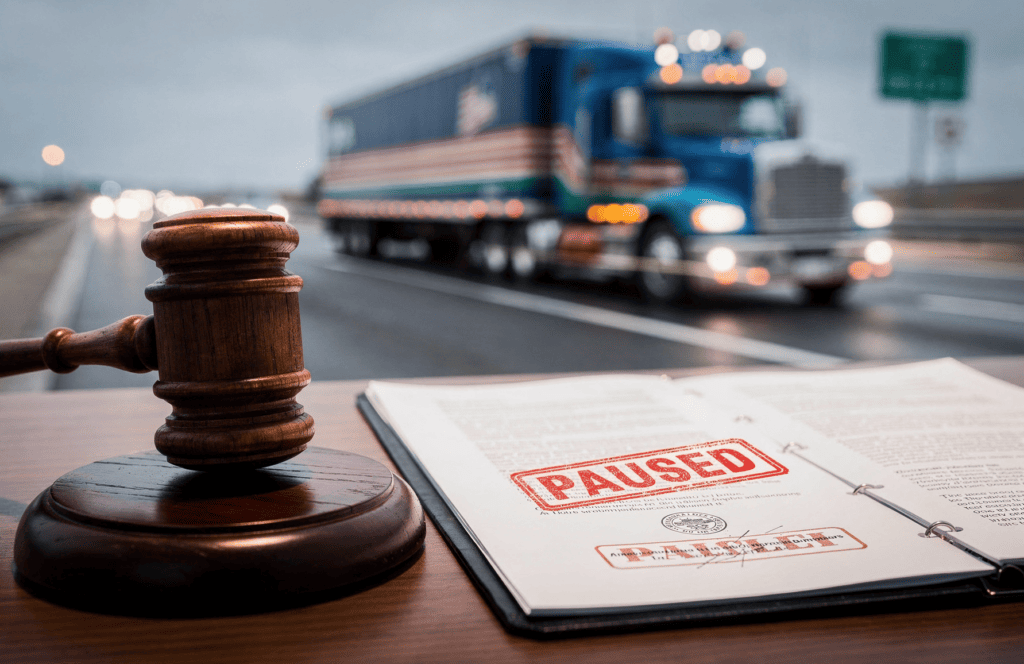
On November 11, the U.S. Court of Appeals for the D.C. Circuit issued a stay, temporarily pausing FMCSA’s non-domiciled CDL rule while litigation continues.
That means:
- States may resume issuing and renewing non-domiciled CDLs under the previous rules.
- Drivers who were blocked from obtaining or renewing a CDL can now move forward again.
- The rule is on hold, not overturned – its fate depends on the court’s final decision in the weeks ahead.
State licensing agencies are now reviewing FMCSA’s earlier guidance to ensure compliance while processing backlogged applications.
What Drivers Should Do Now
- If your CDL renewal was paused, contact your state’s licensing office – many are reopening non-domiciled CDL processing this week.
- Keep your paperwork ready: proof of lawful presence, work authorization, and your U.S. driving record.
- Stay informed: the stay is temporary; the court’s final ruling will determine whether the rule returns or is struck down.
Why It Matters
The pause is a relief for thousands of safe, experienced drivers – many of whom have kept freight moving in the U.S. for years while maintaining spotless safety records.
For an industry already facing persistent driver shortages, this is more than a legal win; it’s a moment of stability. Every driver back behind the wheel helps keep America’s supply chain running.
Back on the Road? We’ve Got Loads Waiting
When CDL renewal timelines remain unclear, shifting toward work that doesn’t require a CDL can help drivers stay active. That’s why some operators look into non-CDL owner-operator jobs with pre-screened freight rather than waiting on regulatory updates.