

Owner-operators and small carriers face one of trucking’s toughest challenges: getting paid quickly enough to cover bills without surrendering too much of their already slim margins. Freight factoring has long been a common response, but in 2025, more owner-operators are questioning whether the benefit of faster cash is worth the cost.
To answer that question, it’s critical to understand not just how factoring works, but what it costs and how it compares with the financial realities of running a truck.
What Freight Factoring Is – and Isn’t
In freight factoring, a carrier sells its invoiced receivables to a factoring company in exchange for immediate cash. The factor advances most of the invoice value upfront, then collects payment directly from the broker or shipper once the invoice matures.
Advance rates vary by provider, broker payment terms, and contract structure, but are commonly reported in the 80%-100% range, with the remaining balance released after payment clears, minus fees.
Factoring in trucking is not a traditional loan. There is no interest rate in the conventional sense. Instead, carriers pay factoring fees for accelerated access to revenue.
What It Costs: The Real Numbers Behind Factoring Fees
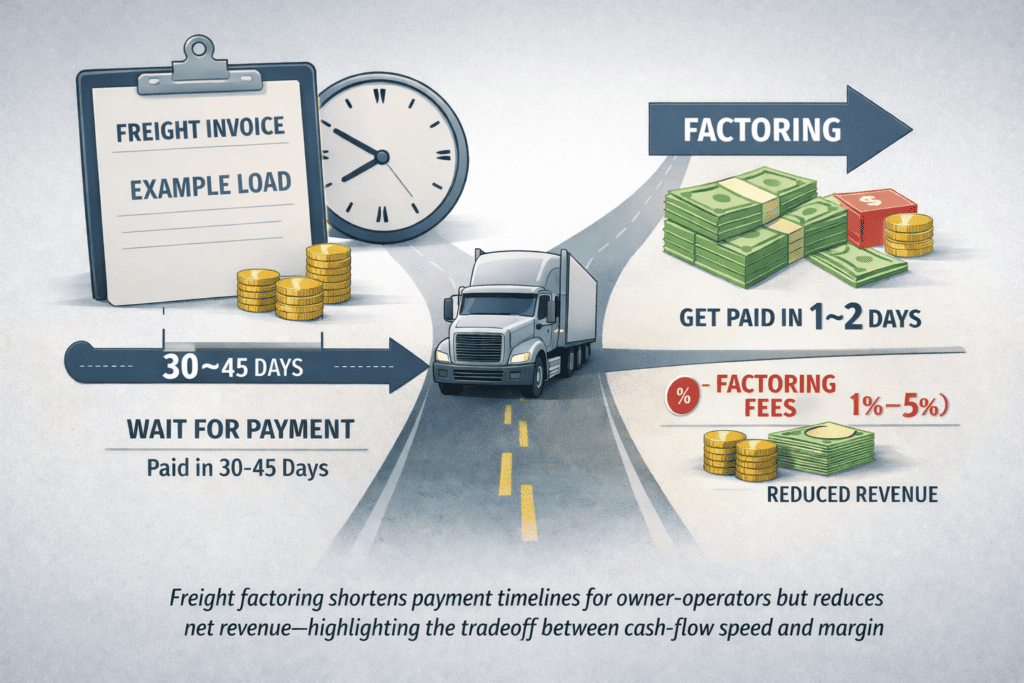
Factoring costs vary widely, but industry sources consistently place factoring fees between roughly 1% and 5% of invoice value, depending on volume, broker reliability, and factoring agreements. Many owner-operators report rates clustering closer to the 1%–3% range under typical conditions.
At face value, those percentages may appear manageable. In practice, the cost compounds. A 2% fee on a $1,000 load reduces gross revenue by $20. Repeated across dozens of loads per month, the cumulative impact becomes meaningful – particularly in a business where trucking profit margins are already narrow.
This is the tradeoff at the heart of invoice factoring.
Why Owner-Operators Use Freight Factoring
The appeal of freight factoring for owner-operators lies in cash flow timing. Brokers commonly operate on 30-45 day broker payment terms, and broker payment delays beyond that window are not unusual.
Freight factoring compresses that wait to one or two business days, providing trucking cash flow predictability.
For owner-operators covering fuel, insurance, maintenance, tolls, and personal expenses, faster access to cash can prevent missed payments and reduce reliance on short-term borrowing. Factoring in trucking also shifts collections and billing follow-ups to a third party, easing administrative pressure.
Trucking Profit Margins and the Cost of Speed
The cost of freight factoring becomes more significant when viewed against the economics of trucking. Industry analyses consistently show that trucking profit margins often fall in the low single digits, frequently between 2% and 6% depending on market conditions.
Against those margins, surrendering even a few percentage points of revenue to factoring fees can materially affect net income. For many owner-operators, the question isn’t whether factoring works – it’s whether they can afford it long-term.
Factoring Agreements, Contract Terms, and Hidden Costs
The advertised factoring rate rarely tells the full story. While some providers promote flat pricing, factoring agreements often include additional costs embedded in contract language or triggered by volume thresholds and broker payment delays.
Industry observers note that per-invoice processing charges, ACH or wire transfer fees, monthly minimums, and early termination penalties are common features of factoring in trucking, particularly for smaller owner-operators.
Over time, these costs can materially raise the effective factoring costs beyond the headline rate, further compressing trucking profit margins.
Many cash-flow problems that push owner-operators toward factoring actually start earlier, often with poor broker vetting and missed freight fraud warning signs.
Trucking Financing Alternatives Gaining Traction in 2026
As carriers reassess freight factoring, some are turning to trucking financing alternatives to stabilize trucking cash flow.
Fuel cards with extended billing cycles allow owner-operators to defer one of their largest operating expenses without paying factoring fees. Business lines of credit may offer lower long-term cost for carriers with strong credit profiles.
At the same time, quick pay options embedded in digital freight platforms are becoming more common, offering faster payment without long-term factoring agreements. Operational improvements – better broker selection, consistent lanes, and disciplined rate negotiation – can also reduce broker payment delays at the source.
A Tool – Not a Default Strategy
Freight factoring remains a legitimate tool for owner-operators, particularly new authorities or carriers navigating uneven cash flow. But in recent years, more operators have begun treating invoice factoring as a situational solution rather than a permanent operating model – a pattern unlikely to change significantly in 2026.
The decision depends on factoring costs, trucking profit margins, access to trucking financing alternatives, and tolerance for administrative overhead.
In a market where every percentage point matters, how – and when – owner-operators get paid has become a strategic decision, not just a financial convenience.
Want fewer payment delays?
Owner-operators running consistent, verified freight often find they rely less on factoring altogether. That’s why some choose to explore owner-operator jobs built around vetted freight opportunities instead of chasing open loads
Frequently Asked Questions
What’s the difference between recourse and non-recourse factoring?
Recourse factoring means you’re still on the hook if the broker never pays the invoice. The factor can pull that money back out of your account or hold it against a future advance. Non-recourse factoring shifts more of that risk to the factor, but it usually comes with a tighter approval process and stricter rules about which brokers and loads qualify. A lot of owner-operators assume non-recourse means zero risk, and that’s not accurate either. Read the contract closely, because “non-recourse” often only applies to broker bankruptcy, not to disputes over freight damage, late delivery, or paperwork problems. If the load gets disputed for any reason outside that narrow definition, you can still end up owing the money back.
How does the factoring fee actually work?
In plain terms, the factor is charging you for taking on the broker’s payment timeline instead of you. The fee generally scales with how long the invoice sits before it’s paid, so a broker who pays fast costs you less than one who drags things out. Some factors charge a flat rate regardless of timing, others use a tiered structure that climbs the longer an invoice ages. Neither approach is inherently better. What matters is whether you understand which one you signed up for, because the two can produce very different totals on a slow-paying lane.
When does factoring genuinely help an owner-operator?
Factoring earns its keep when your business is growing faster than your bank account can keep pace with, or when you’re new enough that lenders won’t extend credit on their own terms. It also helps if you’re hauling for brokers with a track record of paying late, and you’d rather trade a slice of revenue than chase down payment yourself. If steady cash flow lets you take better loads, avoid predatory short-term loans, or keep the truck moving instead of parked waiting on a check, the fee is doing real work for you.
When does factoring end up hurting more than it helps?
Factoring stops making sense when you lean on it out of habit rather than need. If your broker relationships already pay reliably and reasonably fast, you’re paying for a service you barely use. It also hurts when it becomes a workaround for deeper problems, like running lanes that don’t actually pencil out, or working with brokers you haven’t vetted. In those cases the fee just papers over a business decision that needs fixing at the source, and the cash flow relief disappears the moment you stop factoring.
What alternatives exist besides handing over invoices to a factor?
Quick pay programs offered directly by brokers or freight platforms can shorten the wait without locking you into a long-term agreement. A business line of credit, if you can qualify, tends to be cheaper over time for carriers with a solid payment history. Fuel cards that extend billing cycles ease pressure on your single biggest recurring cost without touching your invoices at all. And simply being more selective about who you haul for, favoring brokers with a consistent payment reputation, reduces the underlying problem factoring is built to patch.
What should I watch for in a factoring contract?
Look past the headline rate and read the whole agreement. Ask whether there’s a minimum volume you’re required to factor each month, and what happens if you fall short. Check for early termination penalties, since some contracts lock you in for a set term with a real cost to exit. Ask how disputes and short pays are handled, and whether reserve funds get released on a predictable schedule. Finally, get clear on whether the agreement covers all your invoices automatically or lets you choose which loads to factor. That flexibility matters more than it sounds like once you’re actually running the business day to day.
The Break-Even Test: When the Factoring Fee Pays for Itself
Factoring usually gets argued as a matter of principle: either you keep your margin or you hand a piece of it away. It is better handled as a break-even calculation, and the calculation is one line long.
The fee buys time. So the question is not whether the fee is high; it is whether the time is worth more than the fee:
Factoring pays for itself when:
(loads you could take because you were paid early) × (your net profit per load) > (fee percentage) × (revenue you factor)
Filling that in takes three of your own numbers, and only three.
- Your net profit per load, after fuel, the maintenance reserve, insurance, and the truck payment. Not the gross on the rate confirmation.
- Loads you actually turned down in the last 90 days because cash was not available. Count them from your own records rather than estimating. Most operators guess high here, and a few guess low.
- The share of revenue you would genuinely factor. Factoring every invoice and factoring only the slow-paying brokers produce very different totals against the same fee percentage.
If the left side is bigger, the fee is buying capacity and it pays for itself. If the right side is bigger, you are buying comfort. That is a legitimate thing to buy, but it should be a decision rather than a default.
Two adjustments that keep the test honest
Subtract the loads you would have covered anyway. A fuel card, a credit line, or a broker’s own quick pay would have carried some of those loads without a factor. Those were never blocked by cash, and counting them inflates the case for factoring.
Add what the factor does beyond advancing money. Credit checks on brokers before you book, collections handled without you making the calls, invoicing off your plate. Those have real value and they belong on the same side of the inequality as the extra loads. Otherwise the test understates what you are getting.
Run the whole thing again every quarter. The inputs move. As your reserve grows, the number of loads you could not take for lack of cash tends to fall, and the arithmetic that clearly justified factoring in your first year often stops justifying it by your third. The mistake is not choosing factoring. It is choosing it once and never re-checking.

Table of Content
- What Freight Factoring Is – and Isn’t
- What It Costs: The Real Numbers Behind Factoring Fees
- Why Owner-Operators Use Freight Factoring
- Trucking Profit Margins and the Cost of Speed
- Factoring Agreements, Contract Terms, and Hidden Costs
- Trucking Financing Alternatives Gaining Traction in 2026
- A Tool – Not a Default Strategy
- Frequently Asked Questions
- The Break-Even Test: When the Factoring Fee Pays for Itself